


Feb 6, 2025
NovaLab Tech Solutions
"Responsive and professional supplier with excellent product quality. Communication was efficient, and the entire purchasing process was smooth and reliable."


To select a steel lab fume hood for chemical applications, start with your process, not the catalog. List the chemicals, temperatures, and run times, then match the hood material, liner, and work surface to those hazards. Next, size the hood for your equipment and check airflow against your building's exhaust system. Confirm safety features and test reports, and compare lifecycle cost instead of price alone. Finally, choose a supplier that supports drawings, installation, and spare parts. In this guide, I walk through each step so your plant team can decide with confidence.
Define the Chemical Application and Laboratory RequirementsDocument Chemicals, Temperatures, and Hazards
The steps need to be put down before a good choice can be made. The group should make a list of all the chemicals and write down how often they are used, how strong they are, what temperature they work at, and how they mix with other chemicals. Also, it's risky because of the heat, splashing, corrosive vapors, deadly gasses, chemicals that can catch fire, and reactions that could go wrong. Write down the longest straight run when plants are on all the time. If you use a surface all the time, it will wear down faster than if you only use it sometimes. The OSHA Laboratory Standard (29 CFR 1910.1450) says that companies must have a Chemical Hygiene Plan to protect their workers. People are also more likely to follow the rules after reading this. If the profile is clear, they can also give you the right liner and work surface on the first quote.
Choose what to buy next. One new machine is needed for the quality control room in some plants. Some people want to build a whole lab with a desk, shelves, sinks, and a way for air to flow. We can work with your HVAC tech or get you a special size. Note these things down right away. There are different times for a one-hood order and a twenty-hood order. Before picking a contractor, bidding on the job, and getting the job, most plant projects take between one and four months to figure out what needs to be done. When the scope is clear, it's easy to compare quotes, and once the order is made, reworking stops. It also tells the service provider if you need plans, help on the job site, or workers who have been trained.
Connect the profile to a hood type when you're ready. For most wet chemistry tasks, like working with fluids and getting samples ready, a simple steel lab fume hood that sits on a desk is enough. If your glasses are higher and the reactors are bigger, you might need a floor-mounted or walk-in design. For work with perchloric acid, you need to use a certain type of washdown hood. It won't work to have a machine that can do many things. Steel frames are often used in labs that work with petrochemicals and fine chemicals because they don't catch fire and let a lot of air flow through them. You should also check to see if the frame is stable for moving if you work in pharmaceuticals with small powders. In the plan, you should say if there is a risk that a normal hood can't handle.
There are many parts to a gas hood that all work together to keep you safe from poisons. It's not all the same amount of light that hits the shades, the work area, the sash parts, the handle, and the frame. Most of the time, powder-coated steel works well in chemistry labs. Strong acids are often used on jobs that need to be done with polypropylene, which is good for jobs that need to be tougher or better. Epoxy resin, ceramic, and stainless steel all respond to heat and solvents in different ways, so the work area needs to have a unique look. I always tell people who buy a cabinet to match the surface to the real process, not just the wood. For everything that comes in contact with your fumes, ask for a chemical safety chart.
This is our Uken steel lab fume hood. A sheet of 1.0 mm stainless steel that has been cleaned to keep poisons out makes it up. The smooth surface doesn't let dust stick to it, so you can clean it with plain lab soap. After getting hot, the stuff doesn't bend or change shape. Steel is better than wood or plastic for moving heavy lab equipment because it doesn't catch fire. This makes it safer to use near chemicals and liquids that can catch fire. These qualities help keep the number of repairs and part replacements low over the life of the machine in plants that are open 24 hours a day, seven days a week. Careful quality checks are done on every unit before it is sent out. It is safely packed in strong boxes and has been cleared by CE, ISO, and CQC.
Not all chemicals can hurt stainless steel. Hydrochloric acid and chloride fumes can damage a lot of different types of stainless steel. Check the grade first, then use the chemicals you want to use. Find out about the materials used, the coating, test results, guarantee terms, and how long it will take to get new parts. Having spare parts on hand is very important in continuous plants, where a workstation can't do anything if it's missing a sash part. Before a package leaves Uken, it is tested with salt spray and chemicals to make sure the layer is still strong. Work surfaces must also be able to hold instruments without bending, which is done with mechanical load tests. Check to see what's different after getting the same proof from each supplier.
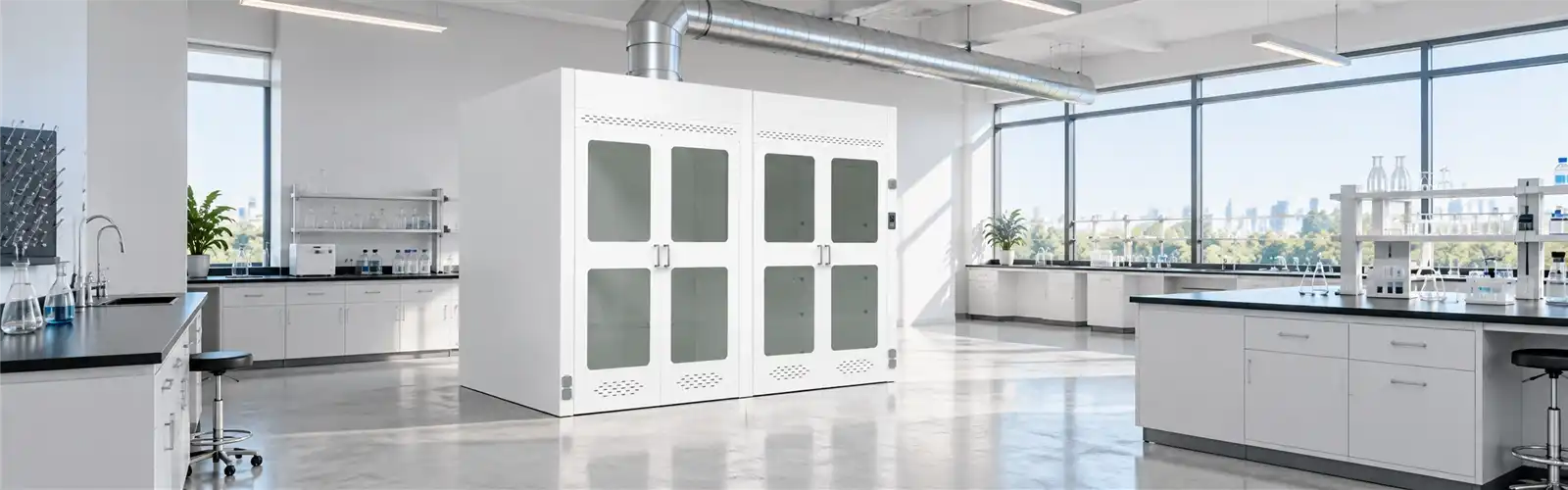
Size should be based on the number of workers, boats, and tools, with extra room for more work. The standard size for our goods is L1200 × D850 × H2350 mm. It's about 47 inches wide. A width of L1500 × D850 × H2350 mm is equal to 59 inches. And L1800 × D850 × H2350 mm is about 71 inches big. Check the doorway's width, the ceiling's height, and the delivery line. Then, look at the outside measurements and compare them to the space you have inside. After that, put up the shelves, sinks, gas faucets, lights, air vents, and curtain around the process. It's not always better to be bigger. More dirty air is pulled in as the hood gets bigger. This brings about more work for the HVAC system and costs more to run.
The vents, fan, ducts, room air, and cabinet must all work together for the hood to do its job. A lot of labs in the U.S. try to get their face speeds to be between 80 and 120 feet per minute at the sash opened. Do not depend on a single number to describe how air normally moves. Check to see how much air is moving, where the window is, the make-up air, how the release is going, and the room's pressure. Containment can become less steady when doors and supply diffusers let air in and out. This is why the room is just as important as the hood. Ask the provider how much airflow they have and set up tests of their work both in the plant and on-site.
Vapors are moved outside of the house by ducted devices. Because they can change with chemicals more easily, these systems work better in plants that make things all the time. You need to keep an eye on ductless units and change their filters often because they need filters that are made to work with certain chemicals. Volatiles could get back into the room if you use a filter that wasn't made for your volatile. It doesn't matter what you choose; you should check how well the duct material fits the fan, how loud and shaking it is, how much power it uses, and how easy it is to change parts. Make that part of your budget for as long as the exhaust lasts. Durable exhaust can hurt fans and pipes before the hood itself does.
As soon as possible, add safety measures to the list of things that are needed. Things like alarms, safety glass, interior lights, position signs, sash stops, and spill control are all helpful. Dangerous liquids can't get out of our hood and into the work area because it has a flap. Safety glass in the door lets you see well and keeps smoke out. It's easier for workers to do their jobs and takes less time to train them, which is helpful when shifts change. But a hat can't take the place of good habits. People who work for you should keep the sash low and not put things inside it. Also, tell them to not use the blocker slots.
Words like "certified" and "compliant" need to be backed up with facts. People in the U.S. usually look at ANSI/ASSP Z9.5 for lab ventilation, ASHRAE 110 for hood performance testing, NFPA 45 for fire safety in chemical labs, and their own country's building and electrical codes before they buy something. People outside of the US often call fume cupboards by the number EN 14175. Tests for face motion, smoke watching, and tracer gas containment are all talked about in ASHRAE 110. Our steel lab fume hood has been approved by CE, ISO, and CQC. We're not the only ones who can ask them how they test each claim. Get the report. After the job is done, a trained professional should check the sash's movement, noise level, airflow, control, and alarms. A lot of places try at least once a year.
The price you pay is not the full amount it costs. It is possible to compare different designs based on how well they handle chemicals, how much airflow they need, how much energy they use, how hard they are to set up, and how often they need to be kept. Then add up all the costs that come with the box, such as the space to work, the utilities, the controls, the pipes, the air fans, the time it takes to set up and take down, and so on. A weighted decision matrix might be useful. Safety should be given the most weight when you are scoring things like compliance, capacity, energy, noise, delivery, service, and price. If you use a hood all the time, one that costs more up front but lasts longer will save you money in the long run. Rust damage, late parts, and unplanned shutdowns are what caused the difference.
The skills of the supplier affect the goods, the plan, and the long-term help. To find out if the company has shipped before, look at their certificates, testing facilities, guaranty, production experience, and lab references. Make sure you know who you're dealing with whether it's a trade company, a distributor, or a local installer. All of these do different technical things. Youken Laboratory Equipment Co., Ltd. is a store that sells medical equipment, lab equipment, and all kinds of Stainless Steel Furniture. There are 100 experts in the 50,000-square-meter building where we work. Our things are safe, according to ISO, CE, SEFA, and SGS. Get engineering sketches, models, and a clear plan for how to handle changes for projects that are OEM or tailor-made.

When you ask for well-thought-out quotes from different sellers, it is fair to compare prices. Write down the reason, the chemicals you want to use, the hood type, size, liner, coating, work area, sash, utilities, noise level, electricity needs, standards, amount, where to carry, and the installation's scope. You should get a price list, shipping plans, models, datasheets, test results, and a price list. Some of the costs that come with owning an HVAC system are tools, ductwork, installation, energy, maintenance, spare parts, downtime, and changes to the system. For as long as your contract lets you, make sure that final acceptance is based on inspection and good work. That one step keeps your plant safe in case it doesn't act right.
A good placement lets someone be alone when they need to be safe. Check out the room's plan to see the floor level, ceiling height, doors, cross-drafts, supply diffusers, emergency gear, and ways to get out of the room. Techs can only change the parts they need instead of the whole system because our hood is made up of separate modules. It's easy to clean with light soaps and doesn't have any rough spots. If you use rough tools, they might leave little marks. Note down everything you check, like the alarms, work areas, finishes, utilities, pipes, fans, corrosion, and the way the sashes move. It is written down when containment starts to break down. This helps get the fix done on time. The machine is well packed so it will be safe on the way to your spot.
Before you buy a steel lab fume hood, you should write down the chemicals, temperatures, and risks you will be working with. This list will help you pick out the material, the lining, the work area, and the type of hood. The amount of containment will depend on how the air moves, the pipes, and the conditions in the room. The right-sized tools should be used. Most people in the U.S. move their faces between 80 and 120 feet per minute. There is proof behind what people say, like safety features and written test methods like ASHRAE 110. The most affordable price isn't as important as how much the product will cost in the long run, how much help you can get from the seller, a full RFQ, and maintenance records. Body made of smooth, heat-resistant 1.0 mm stainless steel with modular parts can be used in plants that run all the time so that replacements don't have to be shut down and cost a lot of money.
It moves air around the area where people are working and into a system that cools it down. It then sends the vapors away from the person who is using it. Air flow, vents, and the sash all work together, and the steel body can stand up to being hit or on fire.
Pick ducts when dangerous vapors or chemicals are changing. Do not work near people who are not supposed to be there or use ductless units with matched filters. That number will tell you what you should do.
You should think about the machine's size, material, work area, utilities, controls, vents, exhaust fans, shipping, and how to set it up. Check out not only the prices of the cabinets but also how much it costs to install them.
Include a list of the chemicals, their sizes, the amount, where they will be supplied, any standards, and the goal for airflow. Also describe the size of the installation. If the seller knows these things, they can give you a correct price.
Uken makes steel lab Fume Hoods and has three standard sizes of 1.0 mm stainless steel units. Are you going to open a new plant lab, update some old ones, or get something from an OEM? They really have CE, ISO, and CQC seals on them, and Uken has 100 engineers ready to help people. List the chemicals you need, their sizes, how much airflow they need, and where they need to go. You can do this by email at service@ukenlab.com or WhatsApp at +8615102909133. Please go to ukenlab.com to learn more. We'll get back to you with an idea and a price quote.
1. Prudent Practices in the Laboratory: Handling and Management of Chemical Hazards, 2011
2. ANSI/ASSP Z9.5 Laboratory Ventilation, 2022
3. ASHRAE 110 Method of Testing Performance of Laboratory Fume Hoods, 2016
4. NFPA 45 Standard on Fire Protection for Laboratories Using Chemicals, 2019
5. Occupational Exposure to Hazardous Chemicals in Laboratories, 29 CFR 1910.1450, 1990
6. EN 14175 Fume Cupboards, 2003