


Feb 6, 2025
NovaLab Tech Solutions
"Responsive and professional supplier with excellent product quality. Communication was efficient, and the entire purchasing process was smooth and reliable."


Although they both remove airborne contaminants from people, a laboratory exhaust cabinet and a fume hood perform different tasks. While a fume hood protects the user while working on chemicals in real time with an open, sash-controlled front, a laboratory exhaust cabinet often offers ventilated, enclosed storage or equipment containment. That difference affects the design of the airflow, the ducting, testing, cost and compliance. Here's how they stack up against each other, what U.S. criteria apply to them, and how to pick the right one. I also explain how we create the Uken laboratory exhaust cabinet so yOur Team may compare specifications with confidence.
Laboratory exhaust cabinet A laboratory exhaust cabinet is a ventilated container which contains chemicals or equipment likely to generate fumes or aromas. Typical applications are volatile reagent storage, solvent confinement, sample storage and small enclosed processes. The unit is connected to a building duct system or a dedicated fan, so the contaminated air may exit the area and not mingle with it. Construction differs. Stainless steel, coated steel and polypropylene are all available with the correct material being dependent upon the chemicals involved. Before purchasing, customers should always check how well it stops spills, how much space it takes up and how well air flows through it.
A fume hood is a crucial safety gear to keep people safe when mixing, heating, moving, or evaporating chemicals. A ducted hood has vents, a work space, an exhaust collar and often an airflow monitor. The sash is movable. Air enters the front entrance, flows over the work area, and exits through the duct. Containment depends on sash position, room air balance, fan capacity and face velocity. The hood is considered a main technical control, but still relies on good user practices and proper ventilation (Prudent Practices in the Laboratory, 2011).
Most of the buyers don't know what the names stand for. In the US it is "fume hood". In British English and in many export catalogs, a ducted hood-style appliance connected to the building ventilation may be called a laboratory exhaust cabinet or laboratory exhaust hood. Other vendors apply the same phrase to ventilated storage. They overlap in this , therefore I would recommend ignoring the product name and reading the spec sheet . Look at the access type. See if a sash or window opens, duct connection, air flow data and intended use. These data assist you comprehend what the equipment is really doing.
The main difference is how you access the contents. If your laboratory exhaust cabinet is built like a storage container, the closed door or window is the principal feature that keeps air out and removes vapors that build up inside. The fume hood has an open front that is the proper working height (usually 18 inches). Air flow is directed inward to keep pollutants out of the face of a person working there. The first strategy stored the emissions control substance. The second shields the person standing at the aperture. Labs that contain liquids and perform operations need both most of the time.
The target airflow is different too. How much air must escape from a storage-style laboratory exhaust cabinet in order to maintain negative pressure within and prevent vapor buildup? It's a matter of face velocity and containment for a hood. The face velocity in many universities is 60 to 120 feet per minute depending upon kind of hood and policy. ANSI/ASHRAE 110 is the standard tracer-gas method for hood containment testing. Ask any supplier for the air flow data of the particular model you are thinking of buying.
Both units tie into building exhaust. Ductwork, make-up air and fan capacity are important. A hood normally moves more air, constantly pulling air from the room with its open front, and that increases energy expenditure over the years. A storage type laboratory exhaust cabinet may flow less air, yet it may be in operation 24 hours a day. Maintenance is different too. Hoods must have sash checks, airflow monitor testing, and containment verification. Cabinets need to be inspected for seal, door, alarm and duct. I tell buyers to think lifecycle cost, not just purchase price.

Start the design using the chemical inventory, sizes of laboratory exhaust cabinets and the building HVAC layout. Define exhaust volume, internal airflow pattern, negative pressure, alarm setpoints, and what happens if the fan stops. The ducting must resist the chemicals, be accessible for inspection and not condense or create excessive pressure loss. Selection of fan must involve static pressure, chemical exposure, temperature, noise and continuous duty. Issues pop up at the intersection of equipment and building systems a lot, so I'd propose having the supplier, the mechanical engineer and the HVAC contractor in one early meeting.
Most U.S. projects require many documentation. OSHA's Laboratory Standard, 29 CFR 1910.1450 requires businesses to have Fume Hoods and other protective equipment in full working order. ANSI/AIHA Z9.5 - Standard for Laboratory Ventilation - asks for testing at least annually. NFPA 45 is fire protection for laboratories that employ chemicals and NFPA 30 is flammable and combustible liquids. NFPA 30 does not require hazardous liquids storage cabinets to be ventilated, and any vent must not interfere with the cabinet's fire protection. Consult your authority having jurisdiction for local construction and fire codes.
Paperwork protects the user and the project. Before I would approve a purchase I would ask for drawings, datasheets, material information, electrical requirements, manuals, warranty terms, test records. Construction, controls and accessories have to be verified by a factory acceptance. Then site validation needs to examine air flow, pressure, duct connections and discharge position. Measurement proof for hoods is ASHRAE 110 containment testing. Schedule validation as a project milestone. A laboratory exhaust cabinet that satisfies all standards on paper can nonetheless operate poorly if installers connect the duct improperly or skip commissioning.
List each chemical, its concentration, physical condition, vapor pressure, flammability, corrosive and poisonous nature and quantity in storage. Temperature range and cleaning products to be used. This list guides material selection, kind and size of ventilation. Allow area for containers, shelves, spill capacity, door clearance and future growth. Some materials require special equipment. Perchloric acid vapors can create explosive perchlorate salts in ducts, hence those procedures need a specific perchloric acid hood with wash-down. Polypropylene-lined laboratory exhaust cabinets are frequently used for hydrofluoric acid work.
Since project buyers are under schedule and cash-flow constraints, the quote needs to be higher than the unit. Check chemical compatibility, air flow, static pressure, fan requirements, alarms and factory testing . Then confirm what the price includes: export packing, shipment documentation, spare parts, guarantee and whether installation is included in the offer. Bring up any OEM or private-label requirements early on, as well as any changes to drawings. If you wait until later to make adjustments, you'll wind up redoing work. Red flags include no airflow data, fuzzy corrosion claims, unsubstantiated certification claims, and quotes that omit fans or installation parts.
Installation includes: site measurement, placement of laboratory exhaust cabinet, duct and fan connection, wiring, alarm setting, air flow balancing and commissioning. Work with the HVAC, electrical, fire protection and safety departments so that no one realizes there's a conflict on delivery day. Arrange for frequent tests of airflow, doors, seals, alarms, ducts, spill trays and fans after handover. Check airflow and pressure annually, at a minimum, possibly sooner following movements or alterations. Replace or repair the unit when corrosion, faulty seals or a change in chemical processes make the unit no longer capable of satisfying performance needs.
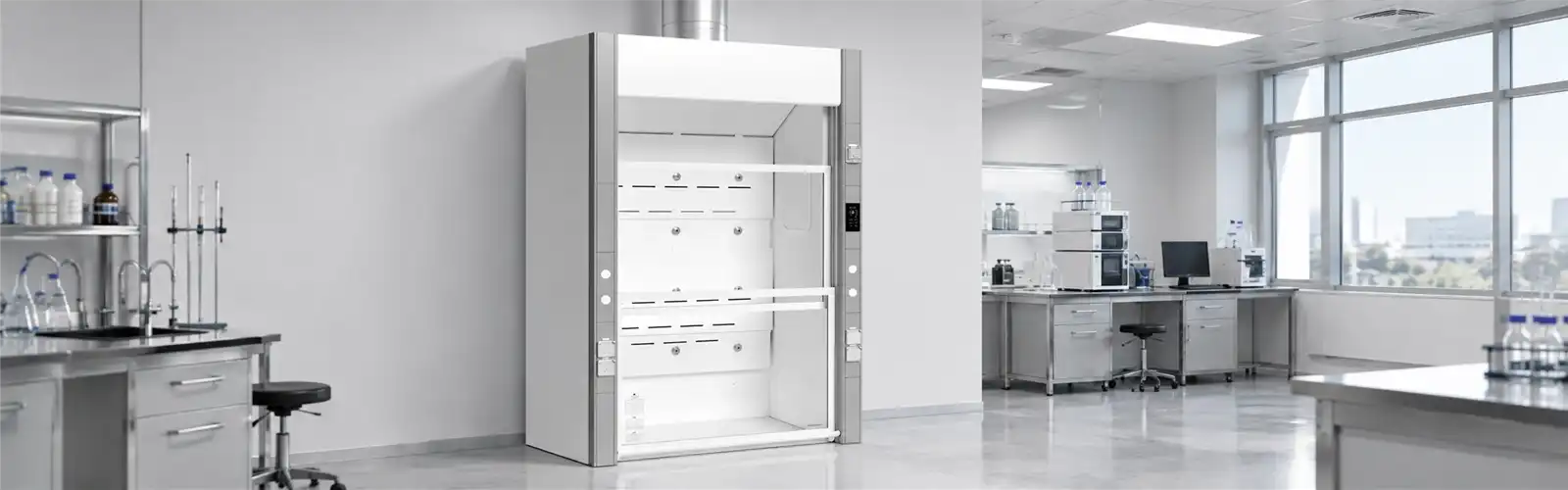
Our laboratory exhaust cabinet is constructed entirely of steel, with an outside shell of at least 1.0 mm steel plate that has been laser cut for tight panel fitting. The coating layer is at least 70 μm thick and each panel is subjected to pickling, phosphating and epoxy powder coating. Pickling removes surface impurities, phosphating promotes paint adhesion and the epoxy coat resists scratches, splashes and everyday wear. Cleaning is a simple wipe down. Its robust steel body resists deformation and maintains tight seams in everyday use.
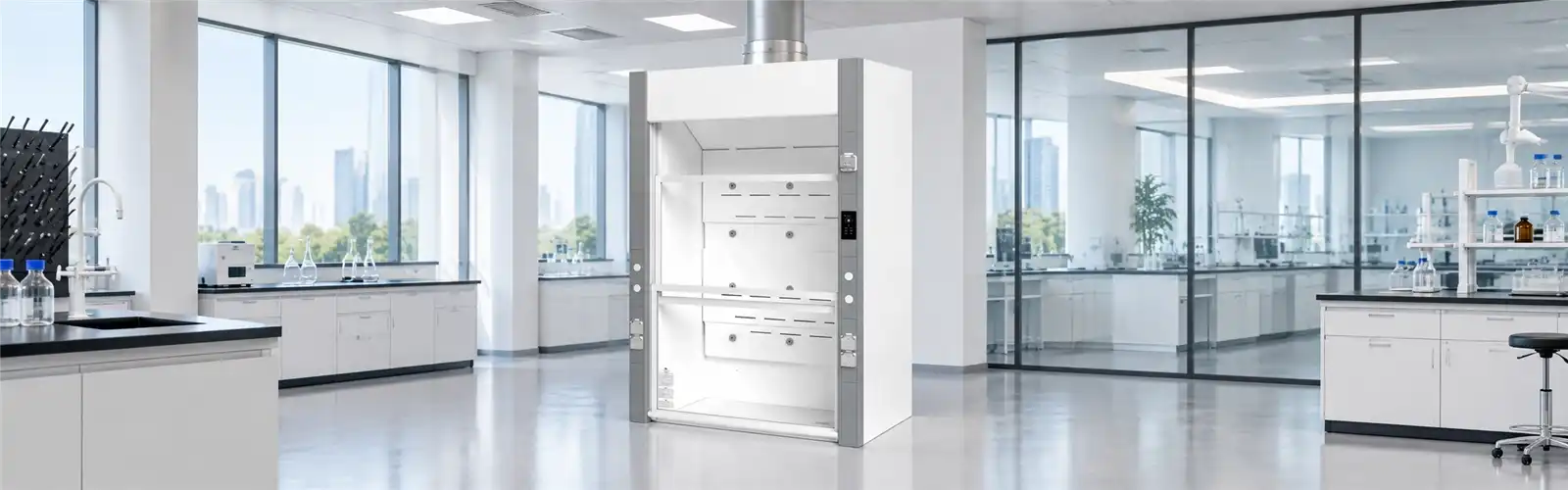
The interior is made with 5 mm corrosion resistant antibacterial board. Corrosion-resistant internal baffles channel air and prevent dead spots where vapors can gather. The viewing window is tempered glass with rubber buffer protector to absorb stress during typical operation. A synchronized belt lift raises and lowers the window so it doesn't dip suddenly or bind and one person can operate it with a controlled motion. The unit is used with building ventilation ducts. The exhaust exits the room. Our engineers consult with each project team on duct size, fan and airflow needs when we are designing.
We have 3 basic sizes, all 850 mm deep and 2350 mm high, with widths of 1200 mm, 1500 mm and 1800 mm. Our production is according to ISO, CE, SEFA, SGS regulations. Pharmaceutical teams use these cabinets to store volatile reagents in the course of synthesis steps. Chemical analysis labs isolate incompatible chemicals, research institutes maintain solvent inventories away from ignition sources, and schools construct multiple units for student experimentation. They are used in hospital laboratories for containment of hazardous material before to disposal. Certifications reflect quality of manufacture but local code review is still required for US projects.
These are the key benefits that matter most to EPC contractors, distributors and OEM purchasers.
These benefits solve frequent project pain points, such as short timelines, shipping damage and corrosion from everyday use.
Fume hoods and laboratory exhaust cabinets are both useful but serve different purposes. While the cabinet permits air to circulate through it, it is really an enclosed, ventilated storage area. And the fume hood protects the worker working at an open sash. Testing procedures Maintenance Energy use All are different How to get at the contents label names vary by area, so specification sheet is more important than label US projects should evaluate OSHA, ANSI/AIHA Z9.5, NFPA and ASHRAE 110 references, ask for paperwork and plan commissioning. Material, size and ventilation determined by chemical inventory. Both are typically needed for facilities that store volatile reagents and do reactions.
No, a storage-type laboratory exhaust cabinet does not safeguard an operator while actively working with chemicals (mixing, heating, reacting, etc.). These tasks should be performed in a fume hood with an open front that draws air inward.
Typically, yes. Vapors need to get out of the room somehow, either by building exhaust or a dedicated fan. Your mechanical engineer should verify airflow and static pressure before ordering.
ANSI/AIHA Z9.5 requires testing at least annually and after any migration or change. If your institution’s policy is stricter, follow that policy.
Provide your chemical list, needed dimensions, air flow data, electrical requirements, standards, place of delivery and any private-label or OEM requirements. We can prepare an accurate proposal with the full details.
Comparing a laboratory exhaust cabinet to a fume hood while planning a project? Simply send Uken your chemical list, dimensions and delivery location and our engineers will offer a design. We provide distributor, EPC, and OEM orders as a laboratory exhaust cabinet manufacturer. For details, please email service@ukenlab.com, message WhatsApp +8615102909133, or visit ukenlab.com.
1. National Research Council, Prudent Practices in the Laboratory: Handling and Management of Chemical Hazards, 2011.
2. Occupational Safety and Health Administration, Occupational Exposure to Hazardous Chemicals in Laboratories (29 CFR 1910.1450), 1990.
3. American Industrial Hygiene Association, ANSI/AIHA Z9.5 Laboratory Ventilation, 2012.
4. National Fire Protection Association, NFPA 45: Standard on Fire Protection for Laboratories Using Chemicals, 2019.
5. ASHRAE, ANSI/ASHRAE Standard 110: Method of Testing Performance of Laboratory Fume Hoods, 2016.
6. National Fire Protection Association, NFPA 30: Flammable and Combustible Liquids Code, 2021.