


Feb 6, 2025
NovaLab Tech Solutions
"Responsive and professional supplier with excellent product quality. Communication was efficient, and the entire purchasing process was smooth and reliable."


Ventilation hood chemistry describes how a chemistry fume hood captures, contains, and removes hazardous vapors before they reach people in the laboratory. Room air enters through the sash opening, passes the baffles, and leaves through the plenum, duct, and exhaust fan to the outdoors. Performance depends on face velocity, even airflow, sash position, make-up air, and chemically compatible materials, not on the cabinet alone. In this guide, I explain each part of the system and show how Uken builds full-steel hoods for schools, universities, and industrial laboratories.
How Ventilation Hood Chemistry Airflow WorksHow a Chemistry Fume Hood Works: From Hazard Capture to Safe Exhaust
A science fume hood does its job all around. The air in the room goes through the sash hole, the work area, and the back baffles slots. Next, it goes into the plenum, then through the ducts, and out the exhaust fan. Containment is changed by every part. If the baffle slot is blocked, the duct run is too long, or the fan isn't strong enough, fumes can get into your lungs. Cross drafts from doors, supply diffusers, or people walking by can also do the same thing. As part of the job, you will often have to deal with solvents, acids, heat, prepare samples, and give training examples. I always think about the chemicals, their amounts, temperatures, processes, and how they will likely be used in the future before I choose a hood.
Face velocity is the speed at which air most of the time comes in through the sash hole. Even though it's a good sign, it's not the only one. OSHA is not needed In the lab, it's 60–100 feet per minute (fpm), which is 0.3–0.5 m/s. Many schools in the US set their own rules at 80–120 fpm. When the speed is too high, the sash edge is rough, and when the speed is too low, capture is weak. To figure out how much smoke there is, multiply the open window area by the speed of the face. It takes about 450 cfm to fill a hole that's 4.5 square feet and 100 feet per minute. Where constant air volume (CAV) is used, exhaust stays the same. Variable air volume (VAV) methods change the amount of air going out as the window moves. It takes more work to set up and control, but it saves energy.
A good hood is made with chemical compatibility, air flow, room balance, maintenance, and monitoring in mind. Epoxy resin, phenolic resin, stainless steel, polypropylene, and ceramic are some of the coatings that can handle acids, solvents, alkalis, oxidizers, heat, and pressure in different ways. Make sure that the cover you pick can handle the chemicals that are on your list. And finally, the fans and ducts need to be able to handle the chemicals, airflow, static pressure, noise level, and discharge modes. It's also important to make up air. It's not stable airflow if the room can't bring in enough air to replace the air that the hood removes. Negative pressure builds up. Your providers should give you test results, material data, conformity papers, installation directions, and records of the start process.
These ventilation hood chemistry hoods use special ducts to vent dirty air outside of the room. They can be used with a lot of chemicals that will change, corrode, be harmful, or be volatile. Without ducts, hoods take air from the room, clean it of chemicals, and then let it back into the room. They are easier to put in, but their performance needs to be proven, and they need to be checked regularly and replaced when they wear out. It is possible for a chemical that is stuck in a filter to be let out into the room. To tell the difference between the two, I look at the list of chemicals, how concentrated they are, how often the work is done, how hot and wet it is, how the building was built, environmental rules, and how much it will cost over its whole life. A split system is not the better choice just because it costs less.
People can stay safe from the vapors, fumes, and gasses that are made when chemicals are used with a chemical fume hood. That's what a biological safety cabinet (BSC) does: it keeps biological things safe. Each class can protect the person using it, the thing they're using, or the surroundings. Many BSCs use HEPA screens, which are good at catching particles but not so good at getting rid of most chemical fumes. Because of this, a BSC shouldn't always be used instead of a chemical hood. When you work with biological and chemical agents together, you need to look at the risks and sometimes build a special shelter. This is what you should do before you buy any tools if your lab does both.
First, think about what you want to do, what chemicals you have on hand, how the process will work, how big the equipment needs to be, and what you will need in the future. Next, look at the walk-in, ducted, split, CAV, and VAV kinds of air units. The noise level, the window height, the chemical protection, the lighting, the service lights, the controls, the energy use, and how easy it is to do upkeep are all things that can be useful. In most classes and labs, a basic hood will work. When the sizes aren't standard, the process is corrosive, the scrubbers are built in, the OEM wants to brand the product, or the design has to work with the services that are already in the building. By writing down these needs on a small sheet of paper, all providers will be able to give the same price range.

It depends on how it's made and how people use it to be safe. Before you turn the engine on, make sure the exhaust is running and the airflow monitor or alarm is set to on. To work, make sure the sash is at the right height, the shield holes are clear, and the tools are far from the front opening. As a general rule, you should be six inches (15 cm) behind the sash line. It is possible to stop cross-drafts by controlling doors and foot movement. Keep the lids on containers closed when they're not in use, and don't store things permanently in the hood because it stops air from moving. When working with hydrofluoric acid, perchloric acid, pyrophoric materials, and chemicals that react quickly, you need to take extra precautions. You need a washdown hood to work with hot perchloric acid.
Ventilation hood chemistry is different for each type of lab. Because students use the hood so much, the chemistry room at school looks for parts that will last and have easy settings that teachers can easily keep an eye on. An industrial quality-control lab needs materials that don't rust, exhaust that works all the time, chemicals that are compatible with different ones, reliable monitoring, and maintenance that is easy to get to. A project for a distributor or OEM is all about building in modules, making measurements that can be used again and again, private-label options, export paperwork, and controls that can be set up in different ways. These are typical situations, not one-offs involving a single customer. At the start of a project, I always do the same thing: I describe the risk and the process. Then I make a list of the design requirements and choose the system. Finally, I check the airflow, containment, installation, and paperwork.
That's right, ANSI/ASHRAE 110 tells us how to test Fume Hoods in labs. It is often used in three stages: as made, as placed, and as used. One of the tests that is done is to measure the speed of the face, see smoke, and keep tracer gasses inside. According to ANSI/ASSP Z9.5, the system can be checked regularly while it is being used. Most programs say that airflow tests should be done at least once a year and again after the HVAC system or pipes are changed. Between tests, the staff should clean the tables, check the sash, check the alarms, and write down the results. Audits are easier to do with written records, and they let you know if airflow is changing before a user knows about it.
All the way through, Uken's ventilation hood chemistry units are made of steel. Lasers are used to cut the steel parts so that they fit properly. Plates that are at least 1 mm thick are then twisted and welded into the shell. With this structure, it stays stable over time and doesn't get loose joints like bolt-together pieces can. Pre-painting the steel with pickling and phosphating makes it clean and helps the epoxy powder coating stick to each shell. The surface is smooth and won't rust or scratch. It's also simple to clean. There aren't any wooden parts in our goods, so fire and water don't pose as much of a threat.
We lined the hood with a 5 mm board that doesn't rust and kills germs. It's easy to clean up between classes or experiments and keeps the steel safe from getting wet. A protected glass sash in the front lets people and students see the work clearly, and a belt lift makes it easy to move. When tempered glass breaks, it doesn't shatter into sharp pieces. They are good for everyday use in the classroom, where clothes get wet and the sash moves around a lot. For stronger drugs, we can talk about other fillers, such as phenolic resin.
L1200, L1500, and L1800 mm are the three common sizes. They are all 850 mm deep and 2350 mm tall. That's about 4 to 6 feet wide, which is the same as most hoods. The shape, size, color, lining, and color can all be changed. If you send us RAL color codes or real samples, we can match the finish. Production models are made by our experts before the product is made. These make sure that the layout works with your HVAC plan and the way you work. I think you should check those plans before you start making things to make sure they show the right electrical points, exhaust connections, and service connections.
You can get accurate quotes from sellers if you ask for them to send you thorough ones. This way, you can compare them fairly. Tell them about the size of the hood, the chemicals and how concentrated they are, the sash's needs, the desired airflow, the materials, the accessories, the layout of the room, the electricity, the standards that apply, the amount, where the delivery will take place, and the paperwork that needs to be filled out. Don't just look at how much the cabinet costs when you get quotes. Look at the price to see if it includes things like tracking, installation, commissioning, testing, packing, guaranty, and fans. When you compare the total scope and lifecycle cost, you lower the risk of buying something and make sure that the project costs don't go over budget.
Someone who has sold a lot of lab fume hoods can help you before, during, and after the sale. Checking for chemical compatibility, estimating airflow, planning, choosing materials, and setting up ducted, ductless, CAV, VAV, tabletop, or floor-mounted systems are all part of the pre-sales help. Quality can be seen in things like checking the dimensions, making sure they work, and writing down control methods. Advice during commissioning and expert help after installation protect performance over the lifecycle. Uken's factory is 50,000 square meters and has 100 professional engineers working there. Standards like ISO, CE, SEFA, and SGS are met by our goods. You can get everything you need for the room from us, like storage boxes, sinks, lab chairs, and more.
It's important to ship and set up because schools and distributors often buy in bulk. Because our boxes are small, they are cheap to ship, and our design makes it easy to put together and take apart. We can handle small orders for lab upgrades as well as big orders of 50 or more units, and we can deliver when it works best for you. OEM and ODM services include making your own logos, changing the plan of the inside, and matching colors to the standards of your building. For US projects, let us know early on what local code, testing, and documentation you need so we can make sure we can provide it.
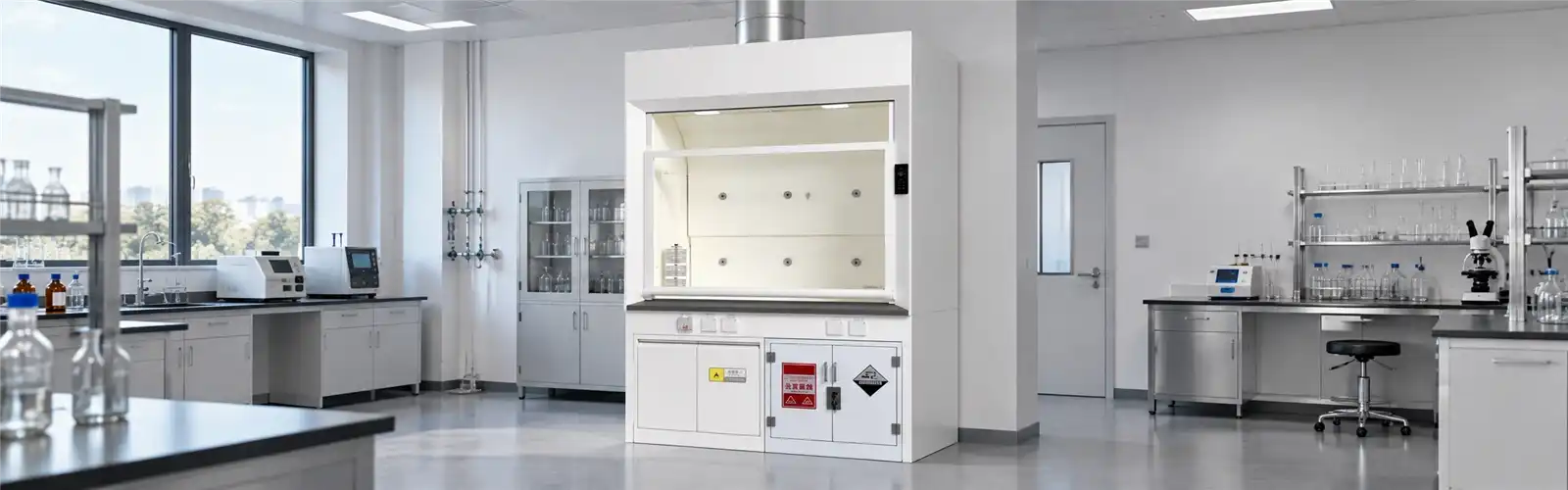
Users are only safe in a science fume hood when the ventilation hood chemistry door opening, filters, plenum, duct, fan, and make-up air all work together. Face velocity, which is usually between 60 and 100 feet per minute (fpm) according to OSHA rules and between 80 and 120 fpm according to institutional rules, is a key indicator, but it needs to be paired with even airflow and controlled cross-drafts. Chemical liners must be made of the same material as the chemicals, ducted hoods are best for most chemical work, and a biological safety cabinet can't be used instead of a chemical hood. Containment is effective because of safe habits, ASHRAE 110 testing, and regular maintenance. When reviewing quotes, it's better to look at the total scope and overall cost than just the cabinet price.
There is no one value that works for all hoods. 50 to 100 fpm is what OSHA Appendix A says, and many US institutions use 80 to 120 fpm. Talk to your safety officer about the goal and the rules that apply.
In most cases, no. HEPA filters catch particles but don't get rid of most chemical vapors.
Most of them test the system at least once a year and whenever the HVAC system or pipes is changed. Stick to the plan your city or town's safety program makes.
Send the chemical list, amounts, process temperatures, hood size, room layout, airflow goal, preference for ducted or ductless airflow, amounts, and delivery location.
Uken is a company that makes and sells ventilation hood chemistry. Their products are made of full-steel and have a 5 mm antibiotic lining, toughened glass sash, and custom sizes. You can email service@ukenlab.com with your list of chemicals, hood size, and amount, or you can text us at +8615102909133 or go to ukenlab.com. For your lab, our engineers will make a clear estimate.
1. Prudent Practices in the Laboratory: Handling and Management of Chemical Hazards, National Academies Press, 2011.
2. ANSI/ASSP Z9.5 Laboratory Ventilation, American Society of Safety Professionals, 2022.
3. ANSI/ASHRAE Standard 110, Method of Testing Performance of Laboratory Fume Hoods, ASHRAE, 2016.
4. Occupational Exposure to Hazardous Chemicals in Laboratories, 29 CFR 1910.1450, Occupational Safety and Health Administration, 1990.
5. EN 14175 Fume Cupboards, European Committee for Standardization, 2003.
6. SEFA 1 Laboratory Fume Hoods Recommended Practices, Scientific Equipment and Furniture Association, 2010.