



What is a fume hood used for in a laboratory?
A laboratory fume hood — also called a laboratory chemical fume cupboard — is a local exhaust ventilation device that captures and removes hazardous vapors, gases, and aerosols generated during chemical work. By maintaining negative pressure relative to the room, it draws contaminated air away from the user's breathing zone through a controlled sash opening and exhausts it safely. According to OSHA, Fume Hoods represent the primary engineering control for protecting laboratory personnel from toxic chemical exposure. Without one, routine procedures like acid digestion, solvent extraction, and organic synthesis carry significant inhalation risk.
Understanding Laboratory Chemical Fume Cupboards
It is helpful to know what a fume cupboard does and what it doesn't do before choosing any other ventilation equipment.
What Sets It Apart from Other Cabinet Types?
A lot of the time, people mix up fume cabinets with biosafety cabinets or laminar flow cabinets. Laminar flow units protect the sample, not the person using it; they send air that has been filtered toward the person using it. Biosafety boxes keep the sample and the person using them safe, but they are only made to keep biological agents inside. A chemical fume cupboard is designed to keep harmful chemical fumes away from the person using it. This makes it the best choice for any process that uses volatile or corrosive chemicals.
How the Airflow Mechanism Works
Through the window hole, the fume cupboard controls the flow of air into the room. The fumes can't get into the room because of the negative pressure. As suggested by ASHRAE 110 guidelines, a movable sash works as both a physical barrier and an airflow regulator. Lowering it limits the opening area and helps keep the goal face velocity, which is usually between 0.3 and 0.5 m/s (60 and 100 fpm).
Key Safety Features to Know
Modern laboratory chemical fume cupboards have alarms that go off when the face velocity drops below safe levels, interior baffles that get rid of dead zones where heavy vapors could gather, and chemical-resistant work surfaces that can handle being in contact with reagents all the time. All of these features work together to lower the risk of exposure incidents during long experimental sessions.
Types and Design Standards of Laboratory Fume Hoods
Not every smoke hood can be used for every task. If you choose the wrong type, there will be safety holes and compliance problems.
Ducted vs. Ductless Systems
Fume hoods with ducts link directly to the vent system of the building and send air outside. These are the most common type used in study and testing settings because they can handle the most chemicals. Ductless hoods use activated carbon filters to trap vapors inside. These filters work for certain chemical ranges, but they need to be changed often and can't reliably handle large amounts of highly toxic vapors.
Specialty Hood Configurations
For work with perchloric acid, you need a special hood with a built-in wash-down system to keep the explosive perchlorate salt from building up. For radioisotope treatments, you need to be in a radiation-protected room with HEPA filters. Standard fume cupboards can't be used instead of these custom configurations, and during the sourcing process, procurement teams should be very clear about the type of application they need to meet.
International Standards That Govern Performance
Use of a tracer gas method for containment tests is governed by ASHRAE 110 (USA). Standards for structural and aerodynamic performance are set by EN 14175 (Europe). SEFA 1 talks about how work surfaces can stand up to physical and chemical damage. Labs that want to get CMA or CNAS accreditation or that have to follow OSHA's laboratory standard (29 CFR 1910.1450) should make sure that any unit they buy comes with test reports that meet these standards.
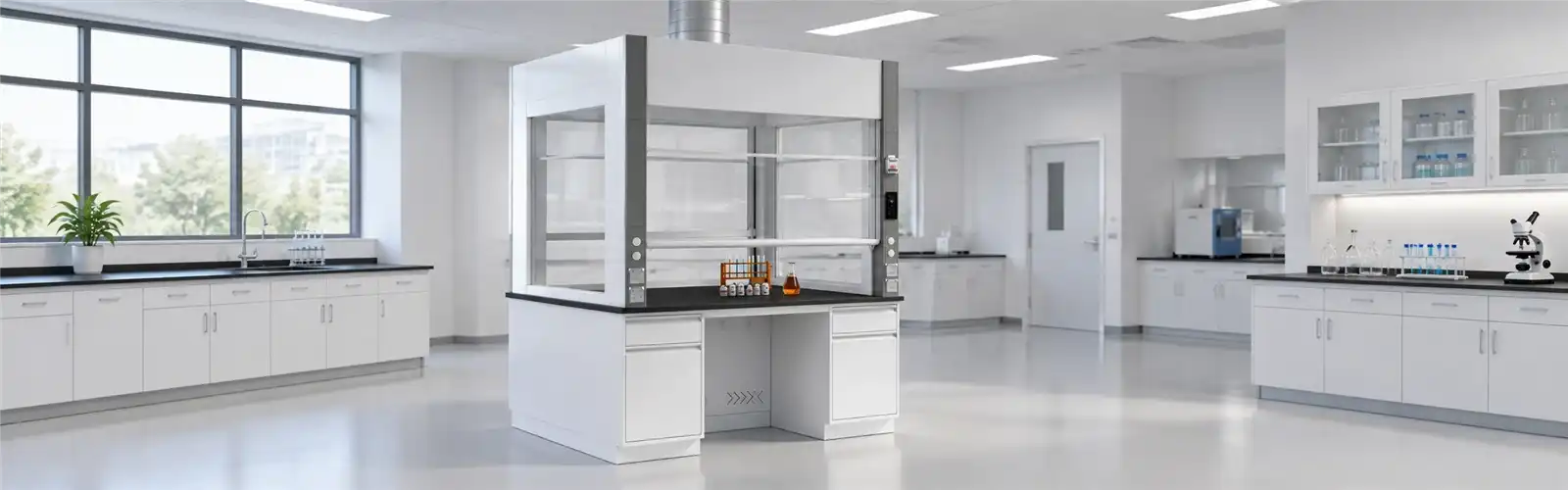
Installation and Maintenance of Chemical Fume Cupboards
Even a well-designed fume room won't work well if it isn't set up and maintained properly.
Site Assessment and HVAC Integration
Before installing a laboratory chemical fume cupboard, experts have to check how much room air changes every hour, how the supply air is distributed, and how much replacement air can be used. Negative room pressure can happen when a fume cupboard lets air out without supplying enough make-up air. This can lead to backdrafting or slower face velocity. This is fixed by variable air volume (VAV) systems, which automatically change the exhaust volume based on the position of the screen. This saves 30–50% of energy compared to constant air volume (CAV) systems.
Commissioning and Face Velocity Verification
A certified industrial hygienist or safety officer should measure the face velocity grid across the sash opening after the installation is done. The ASHRAE 110 smoke visualization test confirms the flow patterns of air and finds any turbulence. These steps must be taken during commissioning because they provide the written proof needed for safety checks and approval reviews.
Routine Maintenance Schedule
For ducted units, certification every year is the norm. The sash operation force, baffle alignment, alarm calibration, and surface condition checks are some of the things that are inspected. For split units, it's important to keep an eye on the filter saturation. Most makers set replacement times for carbon filters based on the chemical load. It's easier to do both internal audits and third-party accreditation reviews when you keep a maintenance log.
Choosing the Right Fume Hood for Your Laboratory
To choose the right unit, you need to make sure that the technical specs match the way you work, not just pick the cheapest choice on a list of options.
Here are the main things that you should think about when choosing equipment:
- Face velocity and baffle design: Look for units achieving consistent 0.5 m/s face velocity with internal three-stage baffles that produce laminar airflow and prevent vapor accumulation in corners.
- Material construction: Countertop height of 850 mm with 1.0 mm cold-rolled steel construction, acid-washed and phosphated, supports both ergonomic operation and long-term corrosion resistance.
- Size flexibility: Width options of 1200 mm, 1500 mm, and 1800 mm accommodate individual research stations through to collaborative or instrument-heavy setups.
- VAV compatibility: VAV-ready systems reduce energy costs significantly over the equipment's operational life while maintaining containment integrity at varying sash positions.
- Storage integration: A floor-standing unit with a base cabinet allows reagent bottles, apparatus, and safety supplies to be stored directly at the workstation, reducing movement during procedures.
These things have a direct effect on both daily safety and long-term compliance with review standards for institutions. Post-installation verification failures are less likely to happen when procurement teams put certified test reports and technical specifications at the top of their list of priorities.
All of these things are met by the Uken laboratory chemical fume cupboard from Luoyang Youken Laboratory Equipment Co., Ltd. The unit is made of 1.0 mm cold-rolled steel and has a polypropylene (PP) cylindrical hood. It has a three-stage baffle system that creates consistent laminar airflow, and the PP material is resistant to chemical attack and lowers working noise. The inside is 955 mm to 1555 mm wide, 645 mm deep, and has a working height of 925 mm to 1135 mm. This means that rotary evaporators, heating mantles, and analytical balances can all fit without any problems. The design fully works with VAV and meets the building standards needed for ISO and CE approval.
Conclusion
A laboratory chemical fume cupboard is more than just a way to let air flow; it's the main safety barrier between lab workers and dangerous chemicals. To pick the right unit, you need to think about how well it moves air, how resistant the material is, its size, whether it works with VAV, and whether it comes with approved test documentation. Whether your lab makes medicines, breaks down acids, or does scientific tests, the process of specifying fume cupboards should be as careful as any other important infrastructure choice. Every talk about procurement should start with verified performance data and compliance paperwork.

FAQ
What face velocity should a fume hood maintain?
According to ASHRAE 110 guidelines, the speed at the sash opening should be 0.5 m/s (100 fpm). For energy efficiency, some sites run at 0.3 m/s with VAV controls, as long as enclosure testing shows that that setting is good enough.
How often should a fume hood be recertified?
The recommended time between certifications is once a year. Also, re-certification is needed after any changes are made to the HVAC system, the room is rearranged, or the unit is moved.
Can a standard fume cupboard handle perchloric acid work?
No, perchloric acid needs a special hood with a wash-down system built in. Standard units let perchlorate salts build up, which can lead to an explosion over time.
What is the difference between CAV and VAV systems?
No matter where the sash is located, a CAV system always lets out the same amount of air. VAV systems lower the exhaust volume in a way that matches the lower sash. This saves 30–50% of energy without affecting containment.
What materials work best for high-acid environments?
The best resistance to concentrated mineral acids and oxidizing agents can be found in polypropylene containers and epoxy-resin-coated steel surfaces. Standard stainless steel isn't as good for being exposed to strong acids for long periods of time.
Do I need a separate air supply system?
Yes. To keep the room pressure balanced and the face moving at the same speed, there needs to be enough makeup air supply. This should be looked at during the site evaluation stage, which comes before the installation.
Request a Quote from Uken — Laboratory Chemical Fume Cupboard Supplier
Certified laboratory chemical fume cupboards made to ISO, CE, and SEFA standards are sold by Uken, which is supported by Luoyang Youken Laboratory Equipment Co., Ltd.'s 50,000 m2 production base and 100 professional engineers. Our units come in flexible, small packaging that makes them easy to put together and saves money on freight costs. Get in touch with our technical team right away to get specs, proof of compliance, and a reasonable quote. You can email us at service@ukenlab.com or go to WhatsApp: +8615102909133.
References
1. American Industrial Hygiene Association (AIHA). Laboratory Ventilation. AIHA Press, 2019.
2. ASHRAE. ASHRAE Standard 110: Method of Testing Performance of Laboratory Fume Hoods. ASHRAE, 2016.
3. European Committee for Standardization. EN 14175: Fume Cupboards — Parts 1–6. CEN, 2019.
4. National Research Council. Prudent Practices in the Laboratory: Handling and Management of Chemical Hazards. National Academies Press, 2011.
5. Occupational Safety and Health Administration (OSHA). Occupational Exposure to Hazardous Chemicals in Laboratories (29 CFR 1910.1450). U.S. Department of Labor, 2020.
6. Scientific Equipment and Furniture Association (SEFA). SEFA 1: Recommended Practices for Laboratory Fume Hoods. SEFA, 2021.

CUSTOMER REVIEWS
What Our Customers Say