



How to Choose the Right Chemistry Lab Working Table for Your Laboratory
Choosing the right chemistry lab working table is one of the most consequential decisions a laboratory planner, procurement manager, or facility engineer can make. The wrong bench can corrode within months, fail under instrument loads, or create compliance gaps that halt operations entirely. This guide walks you through every critical consideration — from material science to supplier evaluation — so you can make a confident, long-term investment for your specific lab environment. Whether you manage a pharmaceutical facility, a university teaching lab, or a GMP cleanroom, the principles here apply directly to your situation.
Understanding Your Laboratory's Needs and Requirements
Before you can compare goods, you need to have a clear picture of what your lab needs every day.
Map Your Workflow and Space Constraints
Start by writing down the experiments that were done, the chemicals that were used, and the tools that were set up on the chemistry lab working table surface. The surface needs of a biology classroom at a university are very different from those of a petroleum testing lab that uses pure sulfuric acid for tests. The Scientific Equipment and Furniture Association (SEFA) says that chemistry lab working tables must be tested against at least 49 standard chemical reagents before any claim of chemical resistance can be believed. The normal desk height of 36 inches is good for standing work, but custom heights around 30 inches are often needed for analytical work done while sitting down.
Identify Functional Requirements Across User Types
In academic labs, safety elements like radius edges and fire-resistant surfaces are very important. For heavy instruments like HPLC or GC-MS systems, industrial and pharmaceutical labs care most about GMP compliance, easy cleaning, and the ability of the structure to hold weight. When OEM buyers buy in bulk, they need uniform sizes, certified materials, and wait times they can count on. Figuring out which user character is best for your business makes sure that every dollar spent helps your surroundings and not someone else's.
Key Features to Consider When Choosing a Chemistry Lab Working Table
Once you know what kind of lab you have, it's easy to evaluate individual product features.
Materials and Chemical Resistance
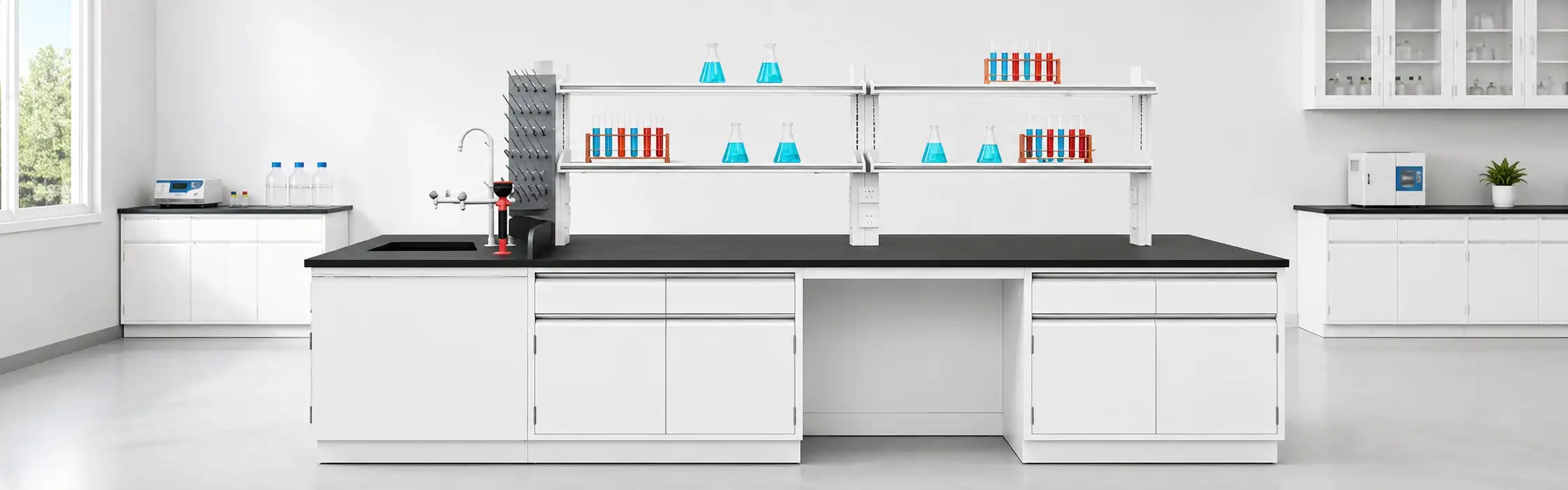
The material of the countertop determines how long a chemistry lab working table will last. Because it is solid and doesn't have pores, epoxy resin is still the standard for high-demand chemical environments. It can stand up to strong acids, bases, and organic solvents for a long time without losing its surface. Solid core physical and chemical board countertops are a cheap option for situations with moderate chemical exposure. Ceramic tops are very resistant to heat and chemicals, making them perfect for places that need to be sterilized, like operation rooms or pharmaceutical cleanrooms. To keep every layer from rusting, the steel base should be made from thicker cold-rolled steel plates that have been treated with acid washing, phosphating, and electrostatic epoxy spraying.
Structural Integrity and Load Capacity
When buying things for a lab, weak frames are often a problem. A fully welded steel frame doesn't have the failure risk that comes with wooden or plastic parts, which can be damaged by water, chemical vapors, and biological growth. Most H-frame designs can hold up to 500 kg per linear meter, while C-frames offer better leg room for sitting work but can only hold a little less weight. The structure you choose should be able to handle your heaviest instruments.
Here are the core performance features that define a high-quality lab bench:
- Full steel construction with no wooden components eliminates moisture absorption, mildew growth, and fire risk. This means it can be used in humid labs where wooden subframes would break down after a few years of regular chemical exposure.
- Epoxy resin electrostatic spray coating is put on all steel surfaces in a three-step process: acid washing, phosphating, and electrostatic spraying. This makes a strong barrier that can withstand acid, alkali, and corrosion even when it comes into daily touch with these harsh chemicals.
- Modular frame design with knock-down assembly allows large chemistry lab working table systems to be shipped in small boxes, which cuts down on freight costs by a large amount. The systems can then be put together on-site without the need for special tools, which cuts down on installation time and labor costs by a large amount.
These features work together to fix the most common problems with lab furniture, including surface corrosion, structural deformation, and dead zones that are hard to clean where chemical residue builds up.
Comparing Different Types of Chemistry Lab Working Tables
There are a number of different chemistry lab working table designs on the market, and each one works best in a different set of circumstances.
Fixed chemistry lab working tables are the most rigid and are perfect for instruments that need to be mounted on anchors and isolated from vibrations. They work perfectly with gas, water, and internet service drops. Modular chemistry lab working tables, on the other hand, can be rearranged to fit the needs of growing research groups or classrooms with students from different fields. A modular system can be taken apart, moved, or made bigger without having to replace the whole installation.
Portable vs. Integrated Fume Hood-Compatible Benches
In food testing or environmental labs where chemistry lab working tables move between zones, portable benches help with mobile sampling processes. When working with volatile organic compounds or corrosive vapors, it's important to have chemistry lab working tables that are designed to fit into Fume Hoods. These chemistry lab working tables must have recessed service fixtures and smooth edges around the edges. OSHA 29 CFR 1910.1450 says that work with dangerous chemicals must be done in well-ventilated areas. This means that a chemistry lab working table design that works with hoods is not an extra feature, it's required by law.
How to Evaluate Suppliers and Place Your Order?
A well-defined product doesn't help if the supplier can't send it on time.
Certifications and Quality Standards to Verify
Manufacturers of reliable laboratory furniture have credentials that are recognized around the world. Check for CE marks, ISO 9001 certification for quality management, ISO 14001 certification for environmental management, and ISO 45001 certification for health and safety at work. These aren't marketing qualifications; they show that the manufacturing method has been checked out. The fact that surface materials have passed standard acid and alkali exposure tests should also be shown in the product documentation, along with SEFA 8-M chemical resistance compliance.
Customization, Lead Times, and Total Cost of Ownership
With custom measurement services, chemistry lab working tables can be made to fit floors that aren't standard. A single cabinet is 470 × 520 × 830 mm, a double cabinet is 900 × 520 × 830 mm, a water tank unit is 1,440 × 720 × 830 mm, and a three-drawer cabinet is 470 × 520 × 830 mm. These standard product features give you a flexible starting point that you can change. For manufactured-to-order chemistry lab working tables, the delivery time is usually between 20 and 40 working days after the order is confirmed, but this depends on how complicated the customization is. The total cost of ownership must include the work for installation, the cost of ongoing upkeep, and the cost of replacing something too soon. These are all things that always favor better initial investments.
Maintenance, Cleaning, and Safety Best Practices
Even the most durable chemistry lab working table needs regular maintenance to keep its ability to withstand chemicals and hold up against damage.
Use gentle soap and water to wipe up spills right away. For tough stains on concrete surfaces, a non-abrasive cream cleaner will get rid of them without scratching the coating. Always stay away from rough pads. Disinfecting is easier on surfaces that are smooth, seamless, and don't have any wood parts. This is especially important in pharmaceutical or medical labs where controlling contamination is required. Check all of the welds, coats, and leveling feet visually once a month. Surface micro-cracking or coating lift in its early stages means that the steel needs to be fixed in a specific area before the chemicals can get into the steel. As processes and staff change every year, ergonomic studies should be done again to make sure that the chemistry lab working table height, reach zones, and seating arrangements still meet OSHA standards and are comfortable for workers.
Conclusion
To choose the right chemistry lab working table, you need to take into account your unique operational setting, material science, structural engineering, spatial logic, and supplier dependability. Epoxy-coated full-steel structure protects against rust and meets load-bearing needs. Long-term needs for reconfigurability can be met by modular systems. Buying from certified suppliers with clear quality control systems lowers the risk of buying something. By going through each of these criteria, purchasing managers, lab planners, and building engineers can choose a chemistry lab working table that works at its best for years without needing to be replaced for no reason.
FAQ
What countertop material is best for high-frequency acid exposure?
For labs that do acid and alkali tests every day, epoxy resin is the best pick. Concentrated sulfuric, nitric, and hydrochloric acids can't break down its solid, non-porous structure. If heat resistance is also important, ceramic tops are an option.
Why does frame material matter as much as the countertop?
It's on the frame that the chemistry lab working table sits. No matter how good the surface is, it will not be stable if the support rusts or bends. In places that are wet and full of chemical vapors, where wood or composite frames fail, full cold-rolled steel frames treated with multi-stage anti-corrosion methods keep their structure.
Can a modular lab bench be reconfigured after installation?
Yes, knock-down modular systems are made so that they can be put together and taken apart without special tools. Because of this, they're great for research departments that are growing or buildings that are being built in stages, since the layouts of the chemistry lab working tables can change as the lab's needs change.
What certifications should I verify before purchasing?
At the very least, check for CE, ISO 9001, ISO 14001, and ISO 45001 standards. For information on how well the surface works, ask for SEFA 8-M chemical protection documents. These approvals show that the product and the way it was made meet standards that have been checked by experts from around the world.
Ready to Specify the Right Lab Bench? Contact Uken Today
All over the United States, Uken provides certified chemistry lab working table options made for chemical, medical, pharmaceutical, and study settings. The chemistry lab working table maker Uken is known for making reliable products that are CE, ISO 9001, ISO 14001, and ISO 45001 approved. Their products can be fully customized, come in modular designs, and are delivered within 20 to 40 working days. To get a quote that fits your building, email our tech team at service@ukenlab.com, or Contact Us on WhatsApp: +8615102909133.
References
1. Scientific Equipment and Furniture Association (SEFA). SEFA 8-M: Recommended Practices for Laboratory Grade Work Surfaces. 2010.
2. U.S. Occupational Safety and Health Administration (OSHA). 29 CFR 1910.1450: Occupational Exposure to Hazardous Chemicals in Laboratories. 2011.
3. International Organization for Standardization. ISO 9001:2015 Quality Management Systems — Requirements. 2015.
4. U.S. Food and Drug Administration (FDA). Current Good Manufacturing Practice (CGMP) Regulations. 2023.
5. American National Standards Institute / Human Factors and Ergonomics Society. ANSI/HFES 100-2007: Human Factors Engineering of Computer Workstations. 2007.
6. National Institutes of Health (NIH), Office of Research Facilities. Design Requirements Manual for Biomedical Laboratories and Animal Research Facilities. 2016.

CUSTOMER REVIEWS
What Our Customers Say