



How Tall Is A Lab Table?
A standard lab table typically stands between 34 and 36 inches (86 to 91 cm) in height. This range reflects widely adopted ergonomic and industry benchmarks suited for general seated or standing laboratory work. The precise height that works best, however, depends on the specific application—whether that's a pharmaceutical testing bench, a university chemistry workstation, or a cleanroom assembly surface. Choosing the wrong height can lead to fatigue, poor posture, and even long-term musculoskeletal injury. Understanding these dimensions is the starting point for any serious procurement decision involving a lab table or laboratory bench.
Understanding Standard Lab Table Heights
The range of 34 to 36 inches isn't just a guess. It comes from ergonomic studies that found this height is a good match for the elbow height of a normal adult standing up straight, letting their arms naturally place themselves while doing lab table tasks (SEFA, 2021). The SEFA says that standard lab table heights are found by measuring from the floor to the worktop surface and should take into account both the person using the table and the type of work being done.
Still, "standard" is just a starting point; it's not the answer. A pharmaceutical worker who is using a pipette needs a different amount of space than a food testing expert who is using a spectrophotometer. When people are sitting down to use microscopes in a medical laboratory, the height of the lab table usually needs to be adjusted. In a cleanroom, on the other hand, the height of the surface needs to be adjusted to allow for full PPE, which can change the effective working height by several inches.
Why 34–36 Inches Became the Industry Baseline?
The 34–36-inch range became popular in part because it is close to the normal height of a kitchen counter, which has already been proven to be good for the health of average-sized people. Both the American National Standards Institute (ANSI) and OSHA agree that working for long periods of time in non-neutral positions greatly increases the risk of joint disorders (OSHA, 2000). Adopting this range by the industry lowers site managers' risk and makes it easier for them to follow larger safety rules at work.
Key Dimensions and Considerations for Choosing Lab Table Height
One thing that can change is height. A full procurement choice needs to look at the actual surroundings, the types of people who will be using it, the tasks that will be done, and the equipment's footprint.
Before choosing a bench height, every buying manager should look at these main size factors:
- User anthropometrics: In places with a mix of workers, one set height doesn't usually work well for everyone. Over time, people who work at a 34-inch lab table may get neck and shoulder pain, while people who work at a 36-inch surface lose their technical edge when they have to do things that require downward pressure.
- Task posture: Sitting at a surface between 28 and 30 inches is best for precision work like microscopy, titration, or putting together electronics. Heavy-duty jobs, like preparing samples or calibrating equipment, are best done while standing at 34 to 36 inches.
- Instrument clearance: A lot of benchtop instruments, like centrifuges, analytical balances, and PCR machines, need specific amounts of space. If the lab table is too high compared to the instrument's control panel, it makes it hard to see and makes mistakes more likely (Laboratory Design Newsletter, 2019).
- Material and structure: The working height is affected by the material of the desk top. The lab tables from Uken are made with a 1.00mm cold-rolled steel frame and a solid core physicochemical board. The board can have a ceramic surface if desired. These options add to the strength of the structure without making the worktop too tall.
All of these things affect whether a fixed or an adjustable bench is best for your facility.
Types of Lab Tables and Their Typical Heights
Not every lab table is made the same. The right type relies on the use, the number of users, and the layout of the building.
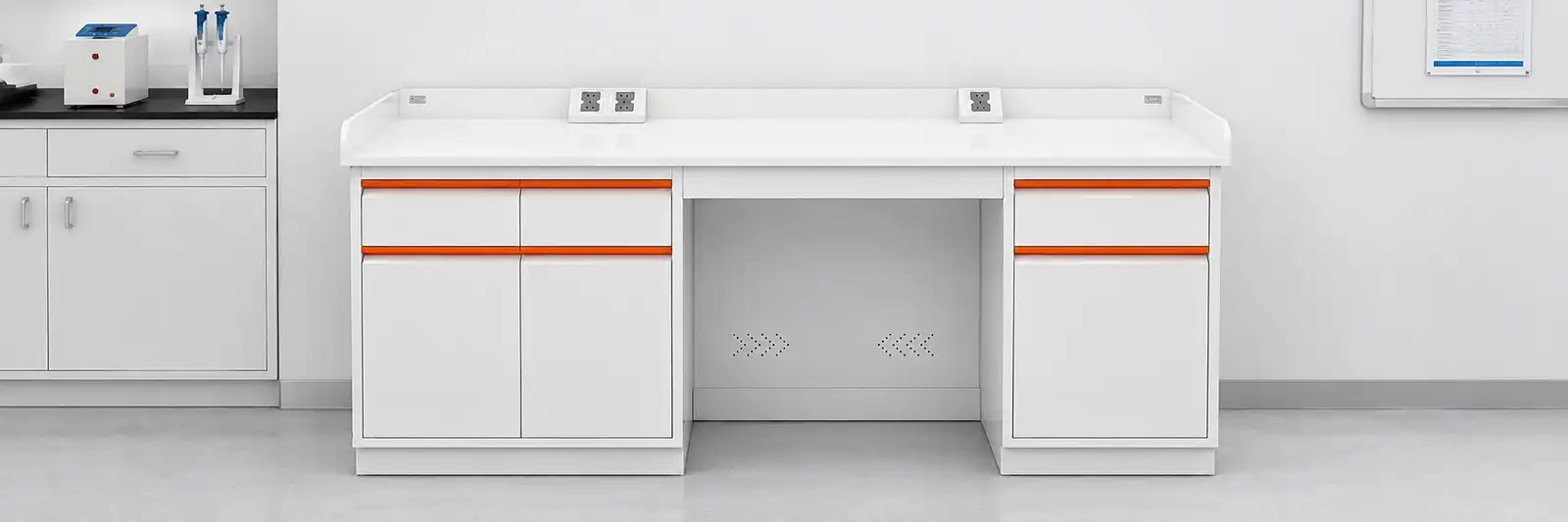
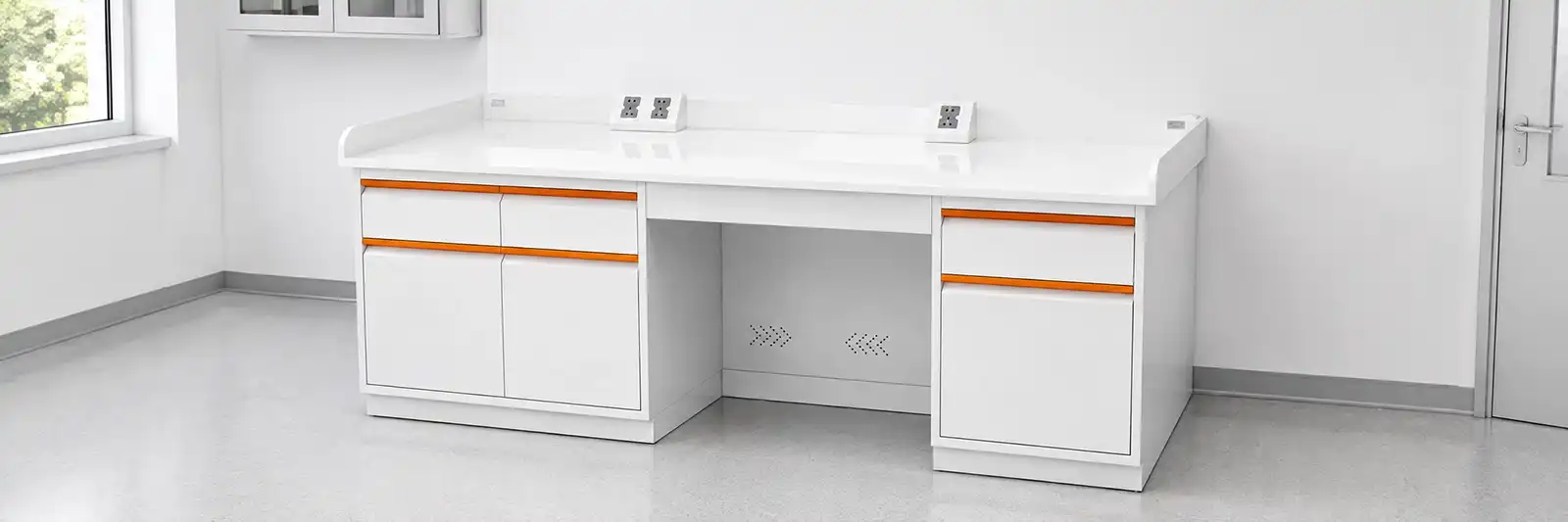
Fixed-height lab tables are still the most common type in both educational and industrial labs. With regular sizes between 34 and 36 inches, they offer uniformity, rigidity, and a lower cost per unit. Uken's fixed designs, such as the single cabinet (470 × 520 × 830mm), the double cabinet (900 × 520 × 830mm), and the water tank units (1440 × 720 × 830mm), are built with the cabinet base at 830mm (~32.7 inches) from the floor, and the worktop height is in the normal range. These units ship in a knocked-down format to save money on shipping, and they can be put together without any special tools.
Adjustable and hydraulic lab tables extend the height range from about 28 inches to 42 inches, so the same space can be used by a wide range of people and for a variety of tasks. These are being asked for more and more in R&D settings where staff changes often or where sit-stand work is required by health and safety rules (Ergonomics in Design, 2020).
Specialized Benches for Controlled Environments
Cleanroom and GMP production lab tables have different height requirements that are based less on user comfort and more on following the rules. To keep microbes from living on surfaces, they need to be smooth, non-porous, and completely seamless. These needs are met by Uken's all-steel modular systems, which have an electrostatic epoxy resin finish that is resistant to acids and bases and easy to clean, which are requirements in GMP workshops for pharmaceuticals and cosmetics.
How to Select the Appropriate Lab Table Height for Your Organization?
When buying lab tables, the decisions you make now will affect how they work in the future. A methodical approach stops specification mistakes and expensive changes made after the fact.
Start by making profiles of your users. Find out from your employees' heights whether they work mainly while sitting, standing, or switching between the two. This helps you decide whether fixed or adjustable lab tables are better. Then, make a map of the task inventory. This will show what tasks are done at each station, what instruments are on top, and what gas, water, and power connections each unit needs to make.
Pay close attention to how well the equipment works together. For everyday use, it's important that the work surface height matches the instrument's control interface. Before finishing specifications for analytical instrumentation labs, I always suggest checking with the equipment maker to see what height is best for the instrument.
Sticking to a budget is also important here. Adjustable-height surfaces are more expensive, but they can hold more weight and are more stable. Fixed-height units are cheaper per unit. The modular system method, like Uken's OEM and ODM customizable line, lets procurement teams standardize across multiple types while keeping sizing options open for big projects involving drug companies, research institutes, or university lab fit-outs.
Common Challenges and Solutions Related to Lab Table Heights
Mismatches in height cause more problems with operations than most facility managers think. When people work at odd angles, it can make them uncomfortable, lead to more sick days, or even damage the tools themselves.
The most common problem in places with multiple users is the single fixed-height lab table that has to serve people of different heights. Without anti-fatigue mats, adjustable seating, or footrests, a surface that works for one person will be hard for someone else to use. Occupational health experts say that these problems should be checked for ergonomic reasons every 12 to 18 months so that they don't get worse (NIOSH, 2022).
In chemistry and pharmaceutical labs, having the wrong surface height adds to the safety risk. When a worker works at an uncomfortably low level, they might lean over cases of dangerous chemicals, which raises the risk of exposure. This problem is made worse by the structure. A lab table that bends or wobbles when it's loaded is unsafe and makes measurements less accurate. This is directly addressed by Uken's full-steel construction and anti-deformation shape, which keeps the stated high load-bearing capacity even after long-term use.
Conclusion
The height of a lab table is a technical issue that has real effects on safety, comfort, and output. The 34–36-inch industry standard is a good starting point, but the best height depends on the user, the task, the instrument, and the conditions in the work area. It's important to carefully choose the right height and the right structural system to support it when setting up a pharmaceutical GMP facility, a university teaching lab, or a food testing center. The all-steel, modular lab table sets from Uken give procurement workers a solid base to build on.
FAQ
What is the standard height of a laboratory bench?
The height of most lab tables is between 34 and 36 inches (86 and 91 cm). This range fits with SEFA and ANSI rules and is thought to be the optimal minimum for standing work in most labs.
Are adjustable-height lab tables worth the extra cost?
Adjustable units greatly lower the risk of ergonomic problems and boost output in places where many people share the same workplace, like hospitals, universities, and shared R&D labs. Most of the time, lower long-term absenteeism and housing costs make up for the higher unit cost.
How does bench height affect instrument performance?
If you use a centrifuge, microscope, or scientific balance at the wrong height, it can lead to mistakes and make it harder to get the same results every time. Align the height of the surface with the instrument's recommended contact height as much as possible.
Can lab benches be customized to non-standard heights?
OEM and ODM customization are available from reputable suppliers. Uken, for example, lets you specify custom sizes with a 20–40 day production wait time. This means that tables can be made exactly how users or tools need them.
What certifications should a lab bench meet?
For basic quality signs, look for CE, ISO 9001, ISO 14001, and ISO 45001 standards. Compliance with SEFA 8 is especially important for how well surfaces work in chemical environments.

Partner with Uken for Your Next Lab Table Project
Uken makes lab table options that are built to last, meet regulations, and be ergonomically precise. We are a reliable manufacturer with 100 professional engineers and a production capacity of 50,000 m². We have CE, ISO 9001, and ISO 14001 certifications for our fixed, movable, and custom-built units. To keep shipping costs low around the world, our modular steel systems come in compact packaging. Get in touch with Our Team right away to get a personalized advice and quote. You can email us service@ukenlab.com, or Contact Us on WhatsApp: +8615102909133.
References
1. Scientific Equipment and Furniture Association (SEFA). SEFA 8: Recommended Practices for Laboratory Furniture. 2021.
2. Occupational Safety and Health Administration (OSHA). Ergonomics: The Study of Work. U.S. Department of Labor, 2000.
3. National Institute for Occupational Safety and Health (NIOSH). Work-Related Musculoskeletal Disorders Prevention. CDC, 2022.
4. Laboratory Design Newsletter. "Instrument Compatibility and Bench Height Specification in Analytical Laboratories." 2019.
5. Ergonomics in Design. "Sit-Stand Workstations in Laboratory Environments: A Practical Review." Human Factors and Ergonomics Society, 2020.
6. American National Standards Institute (ANSI). ANSI/HFES 100-2007: Human Factors Engineering of Computer Workstations. 2007.

CUSTOMER REVIEWS
What Our Customers Say