



Guide to Walk-in Fume Hood Design and Applications
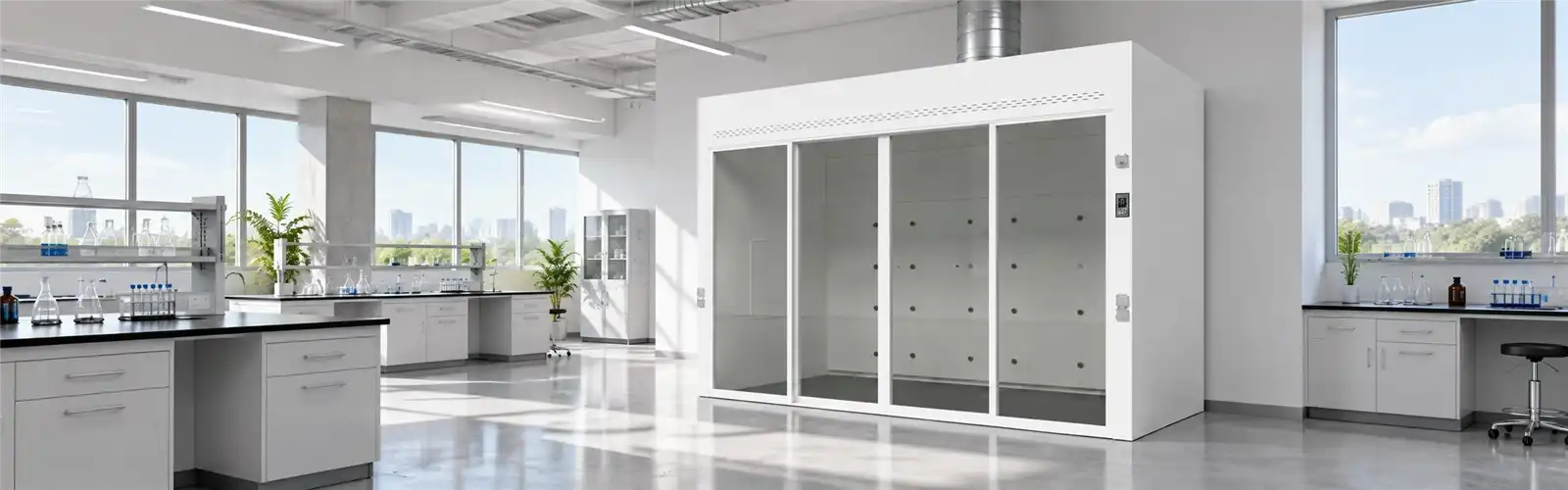
A walk-in fume hood is a floor-mounted laboratory ventilation enclosure designed to house large-size equipment, tall apparatus, and hazardous chemical processes that surpass the physical capacity of ordinary tabletop versions. This floor-to-ceiling design allows researchers direct access to the floor, accommodates roll-in equipment carts, and maintains negative pressure confinement during large-volume chemical processing, unlike traditional hoods. Research institutions in the aerospace, pharmaceutical, and materials science industries rely on these systems to comply with OSHA exposure limits and international safety regulations. This book includes design concepts, selection criteria, installation procedures, and procurement tactics to help you with your next facility improvement.
Understanding Walk-in Fume Hoods: Design and Core Features
Core Structural Components
A floor-mounted fume hood is composed of a number of load-bearing panels, a sash assembly, internal baffles, and an integrated exhaust duct connection. The cage rests immediately on the floor of the facility and provides a working environment, normally 2,350 mm high. The physical layout permits the use of 55-gallon drums, multi-stage distillation columns, and big reactors without the space constraints of traditional benchtop systems. The cabinet is constructed of thicker cold-rolled steel, which is acid-washed, phosphated, and electrostatically sprayed to provide acid, alkali, and corrosion resistance.
Airflow Dynamics and Containment Standards
Effective confinement is achieved by maintaining a constant face velocity throughout the sash opening and smooth internal flow patterns. Yuken's floor-mounted fume hood is provided with a multi-duct laminar flow air supply system and a three-stage deflector and conical airflow collecting structure. This design will evenly extract volatile organic molecules from all four corners of the container. The system provides an exhaust air flow of 220 – 360 m³/h at standard height, with an approved air leakage rate according to CE, SEFA, and ASHRAE 110 performance standards.
Ventilation Types and Energy Efficiency
Ducted systems link directly into a facility’s HVAC exhaust network and remain the norm for labs working with harsh chemicals. Youken’s design has a 60% make-up air ratio, which dramatically decreases conditioned air consumption compared to 100% exhaust versions, reducing yearly running expenses while still providing containment. The exhaust system is connected to the top and lower storage cabinets to maintain the solvents contained there under constant negative pressure. This design is especially applicable to GMP production workshops, aerospace testing cells, and pilot plant situations where energy costs are tightly scrutinized.
Key Considerations for Selecting the Right Floor-Mounted Fume Hood
Size Options and Custom Configuration
Youken offers three standard footprints to match different equipment profiles:
- L1200 × D850 × H2350 mm — suited for single tall apparatus or compact pilot-scale reactors requiring focused containment.
- L1500 × D850 × H2350 mm — the most common selection for chromatography racks and multi-component distillation setups where lateral workspace is needed.
- L1800 × D850 × H2350 mm — recommended for aerospace component testing rigs and large materials curing operations where multiple instruments operate simultaneously.
Each size supports roll-in cart access, eliminating the ergonomic risk of lifting heavy containers onto elevated surfaces. Frame-type structural upgrades are available for facilities requiring reinforced load-bearing capacity to support dense instrumentation racks.
Walk-in Hood vs. Standard Benchtop Hood
The decision between a floor-mounted unit and a conventional walk-in fume hood typically comes down to apparatus height and process scale. Standard benchtop hoods serve well for small-volume analytical work. However, when a reactor vessel exceeds 600 mm in height, or when pressurized release events are possible during scale-up, a floor-mounted enclosure provides the physical barrier and extraction capacity that benchtop models cannot match. Materials science laboratories testing large structural components and pharmaceutical facilities housing automated liquid handling robots consistently select floor-mounted configurations for these reasons.
Total Cost of Ownership
Energy consumption, maintenance frequency, and spare parts availability all factor into long-term value. The 60% make-up air ratio in Youken's design reduces HVAC load compared to full-exhaust hoods. The modular assembly of cold-rolled steel panels simplifies disassembly during maintenance without requiring specialized tools, keeping service intervals short and labor costs predictable.

Installation, Maintenance, and Operational Best Practices
Installation and HVAC Integration
Proper installation starts with a site study to verify floor load capability, exhaust duct routing, and make-up air supply locations. Youken’s project team of 100 engineers works directly with facility HVAC and safety experts to develop duct connection drawings and commissioning checklists prior to delivery. This pre-installation coordination minimizes on-site modification time and guarantees that the system is operating at design face velocity from day one.
Routine Maintenance Protocols
Routine maintenance preserves investment in people and equipment. Major jobs include the monthly examination of sash seals and baffle alignment, quarterly test of exhaust air flow against the 220–360 m³/h criteria, and the yearly inspection of all cabinet exhaust connections. Optional fireproof chemical cabinets, waste liquid cabinets, and waste bin systems should be checked for airtight duct connections at the same time. Documenting these tests helps with regulatory audit preparation.
Troubleshooting Common Operational Issues
The most common performance problem is a decline in face velocity, usually caused by a partial blockage of the sash or a change in duct static pressure caused by nearby equipment. Audible alarms in continuous airflow monitors notify operators of a drop in containment performance. Youken also offers after-sales technical assistance and replacement parts availability to minimize downtime, which is always a top selection consideration for the procurement teams at national research institutions.
Procurement Strategies and Supplier Insights
Evaluating Supplier Qualifications
Certification status is the first filter when comparing floor-mounted fume hood manufacturers for walk-in fume hoods. ISO 9001 production management, CE product certification, SEFA performance standards, and SGS third-party verification together confirm that a supplier meets both manufacturing quality and product safety requirements. OEM production capability and verifiable project references in aerospace, military research, or pharmaceutical GMP environments indicate the design experience needed for non-standard configurations.
Pricing, Lead Times, and Custom Orders
Large-scale non-standard orders typically carry a 6–18-week production lead time depending on structural modifications and duct configuration complexity. Procurement teams should request itemized quotations that separate cabinet structure, exhaust components, optional safety accessories, and on-site installation. Youken's 50,000 m² production base supports concurrent manufacturing of multiple units, which is relevant for institute-scale projects requiring several identical enclosures for a single test facility.
After-Sales Support and Spare Parts
Reliable after-sales response shortens operational downtime and protects the procurement team's internal accountability. Confirm that a supplier maintains replacement sash components, baffle modules, and exhaust connection hardware in stock. Youken's service model includes on-site commissioning, operator training, and documented warranty coverage, giving procurement officers and research PIs a clear record of post-delivery obligations.
Applications and Case Studies: Real-World Usage
Aerospace and Materials Science Testing
Aerospace research facilities conducting component off-gassing tests require enclosures that handle both toxic vapor loads and the physical dimensions of structural test articles. Floor-mounted Fume Hoods with 360 m³/h extraction capacity provide the air change rate needed to maintain safe breathing zone concentrations while accommodating large test rigs.
Pharmaceutical Pilot Plant Scale-Up
A pharmaceutical R&D center scaling from bench to pilot plant faces a common challenge: standard hoods cannot house 100L glass reactors or multi-stage condenser assemblies. Floor-mounted enclosures with laminar flow air supply resolve this directly, keeping operators safe outside the sash line while the full reactor assembly operates inside the containment zone.
Future Technology Trends
IoT-enabled airflow monitoring is becoming standard in high-complexity research environments, allowing facility managers to track face velocity data remotely and generate compliance reports automatically. Sustainable construction materials and variable air volume controls are also entering specifications for new national laboratory builds, trends that align with the energy-saving architecture already present in Youken's 60% make-up air design.
Conclusion
Choosing the correct floor-mounted ventilation enclosure such as a walk-in fume hood for a large-scale research or pilot plant application calls for careful consideration of airflow engineering, size configuration, energy efficiency, and supplier capabilities. The design concepts presented here – laminar flow air supply, certified leakage rates, integrated cabinet exhaust, and modular construction – provide the technological basis for safe and efficient operation. Align these requirements with the real dimensions of the equipment at your plant and its safety standards early in the procurement process, and you will save money on redesign later. Youken’s recorded expertise on projects in pharmaceutical, aerospace, and materials research contexts offers the technical basis for difficult, non-standard installations.
FAQ
1. What routine maintenance does a floor-mounted fume hood require?
Monthly sash seal and baffle inspections, quarterly exhaust air flow verification against the 220–360 m³/h design specification, and annual review of all cabinet duct connections are the standard maintenance schedule. Keeping written records of each inspection supports regulatory audit requirements.
2. When should I choose a ducted system over a ductless model?
Ducted systems are the correct choice whenever the laboratory handles aggressive solvents, reactive chemicals, or processes that generate high vapor concentrations. Ductless models are acceptable only for low-concentration applications with validated filter media. For pilot plant, aerospace testing, and GMP production environments, a ducted floor-mounted enclosure is required.
3. What certifications should I verify before purchasing?
Confirm that the supplier holds ISO 9001 for manufacturing management and that the product carries CE, SEFA, and SGS certifications. These marks confirm both production quality and product performance against internationally accepted laboratory safety standards, which is a standard requirement in government research institute procurement.
4. How long does installation typically take?
On-site installation for a single floor-mounted unit generally takes two to four days when pre-installation HVAC coordination is complete. Multi-unit projects for large research institutes may require two to three weeks depending on duct routing complexity.

Partner with Uken for Your Next Walk-in Fume Hood Project
Uken delivers certified walk-in fume hood solutions backed by ISO, CE, SEFA, and SGS qualifications, with a 50,000 m² production base and 100 engineers ready to support your non-standard design requirements. Whether you need a single pilot plant enclosure or a multi-unit installation for a national laboratory, Our Team manages the full process from specification review through on-site commissioning. Contact our team at service@ukenlab.com to WhatsApp: +8615102909133 request a project consultation and quotation.
References
1. American Industrial Hygiene Association (AIHA). Laboratory Ventilation, 4th Edition. AIHA Press, 2020.
2. ASHRAE. ASHRAE 110-2016: Method of Testing Performance of Laboratory Fume Hoods. American Society of Heating, Refrigerating and Air-Conditioning Engineers, 2016.
3. Scientific Equipment and Furniture Association (SEFA). SEFA 1-2010: Recommended Practices for Laboratory Fume Hoods. SEFA, 2010.
4. National Institute for Occupational Safety and Health (NIOSH). Engineering Controls for Occupational Exposure to Hazardous Chemicals in Laboratories. NIOSH Publication No. 2022-100. CDC/NIOSH, 2022.
5. DiBerardinis, L. J., et al. Guidelines for Laboratory Design: Health, Safety, and Environmental Considerations, 4th Edition. Wiley, 2013.
6. Occupational Safety and Health Administration (OSHA). Occupational Exposure to Hazardous Chemicals in Laboratories: 29 CFR 1910.1450. U.S. Department of Labor, 2021.

CUSTOMER REVIEWS
What Our Customers Say