



Creating Dynamic School Lab Workspaces with Modular Laboratory Furniture
Using modular laboratory furniture to create flexible school lab workspaces is a highly effective way to improve learning settings, providing schools with exceptional freedom and long-term value. Modern lab tables for schools are not fixed pieces of furniture; instead, they are smart, changeable systems that can change to fit changing STEM curriculums, limited budgets, and different teaching styles. Schools all over the US are finding that modular designs cut down on renovation costs by a huge amount and make students safer and more engaged by giving them desks that are scientifically designed to last for years of heavy use.
Understanding Modular Laboratory Furniture and Lab Tables for Schools
What Makes Modular Laboratory Furniture Different
Because it is made up of separate parts, modular laboratory furniture is very different from standard set installations. Each desk is made up of separate, replaceable parts that can be moved around, enlarged, or changed in any way possible without having to make structural changes to the building. One of the biggest worries for building managers is how to deal with changing enrollment numbers and educational goals without having to spend a lot of money on new equipment.
Our lab tables for schools modular systems are made from cold-rolled steel plates that are 1.00 mm thick. This gives them structural strength that standard wooden or composite options can't match. The electrostatic epoxy resin finishing is very resistant to chemicals like acids, alkalis, and solvents that are often used in school science classes. This makes the furniture last longer, which means that over its 20–25-year life, it costs less to own.
Types of Lab Tables for Schools in Educational Environments
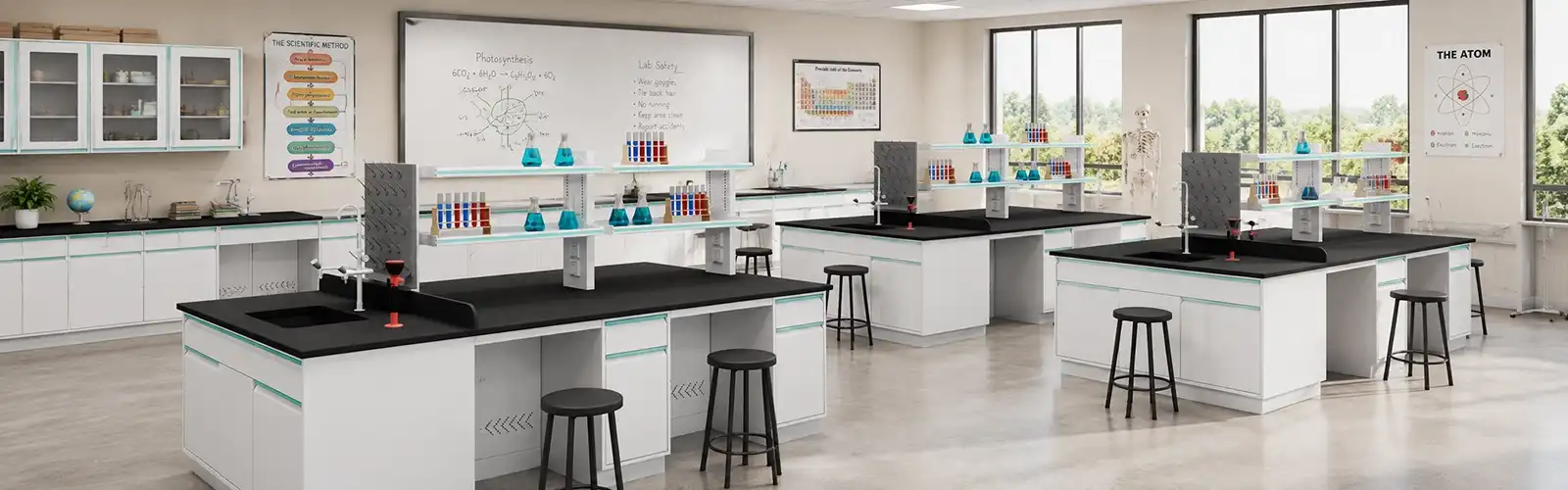
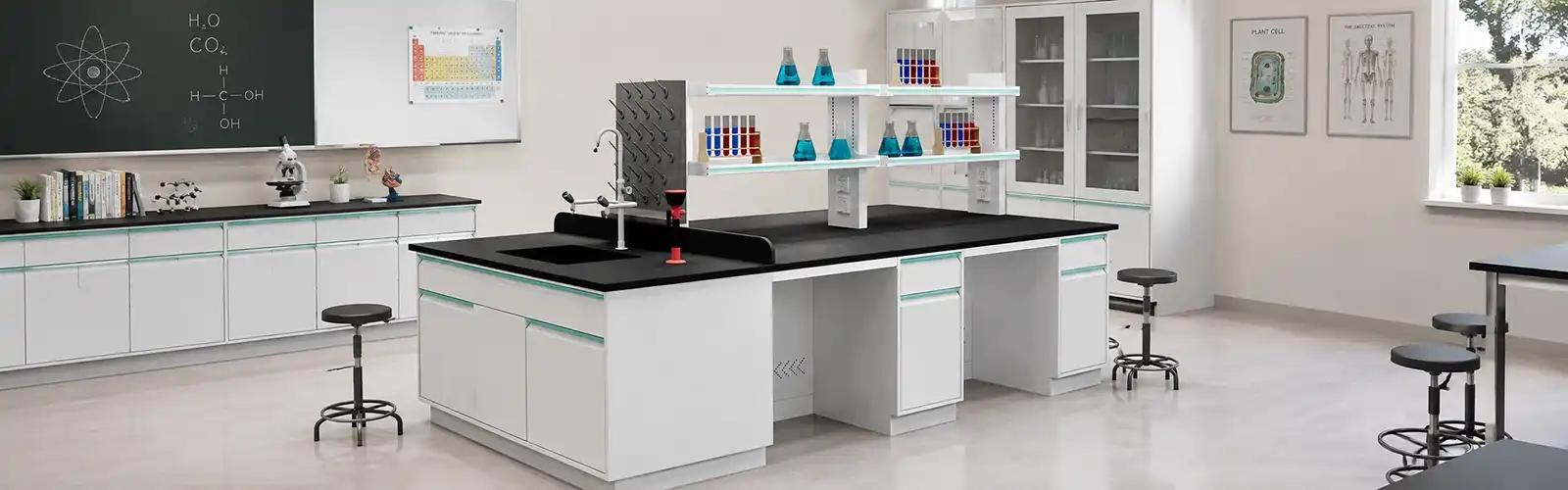
Lab tables for schools used in educational laboratories are very different depending on what they are used for. Wall-mounted benches make the most of the space on the floor in small classes and provide a stable area for projects that use a lot of tools. Island layouts help students work together to learn because they let them work in groups while still having good views of the teacher. Mobile desks with industrial-grade locking casters make it easy to rearrange the room quickly, which supports project-based learning methods that are becoming more popular in STEAM education.
Another important problem that storage-integrated designs solve is how to organize lab tools and student materials efficiently. Our double cabinet units (900 × 520 × 830 mm) offer a lot of safe storage space in a small space. Water tank stations (1440 × 720 × 830 mm) build important services right into the workstation, which makes placement easier and makes sure the station meets all building codes.
Material Selection and Safety Compliance
The materials used for the work area have a direct effect on both how safe it is and how much upkeep it needs. Solid-core physicochemical boards can withstand heat up to 350°F, chemical entry, and contact damage. They also have a smooth, non-porous surface that stops germs from growing. For advanced science uses, ceramic countertops are even better at withstanding heat because they can handle direct flame contact without breaking down.
All materials used in lab tables for schools meet CE, ISO9001, ISO14001, and ISO45001 standards. This gives purchasing managers proof that the materials are safe and of good quality. These certifications help ease the regulatory load that many building managers have to bear when they have to explain their buying decisions to school boards and other government oversight groups.
Challenges in Designing Dynamic School Lab Workspaces and How Modular Furniture Solves Them
Space Utilization and Flexibility Constraints
When schools place traditional lab furniture, it can lock them into set arrangements that aren't useful as teaching methods change. It's hard for a chemistry lab that was made for single-student work to handle the group, cross-disciplinary projects that are now popular in Next Generation Science Standards classes. Facility managers have to make the tough decision of whether to spend a lot of money on improvements or keep using learning spaces that aren't up to par.
Because lab tables for schools with modular designs can be reconfigured, this problem is eliminated. The knock-down structure lets you completely change the layout of the room over the summer without having to hire special builders or make any structural changes. Depending on the needs of the semester's curriculum, a single lab space can be set up in rows, shared islands, or display layouts. This flexibility makes the building investment last longer while always making the learning setting better.
Durability and Maintenance Burden
When people are trying to save money, they sometimes choose the lowest starting cost over the best long-term performance. This can lead to furniture that needs to be repaired or replaced all the time. Surface wear, corrosion from chemical spills, and structural failure under standard load all pose safety risks and add to the cost of planned and unplanned upkeep, which puts a strain on building budgets that are already tight.
We directly address these issues in our lab tables for schools with all-steel structure and multi-stage anti-corrosion treatment. The process of acid cleaning, phosphating, and electrostatic spraying makes a barrier that protects and can survive decades of rough lab use. Because there are no seams or cracks in the surface, chemicals can't build up there. This makes regular cleaning easy and effective. Facility managers say that care takes 60% less time than with standard wood or particle board options.
Implementation Process and Risk Mitigation
Putting in new lab chairs can be hard to organize, which can mess up class plans and put a strain on staff resources. What should be an easy upgrade turns into a stressful and time-consuming job when there are complicated installation steps, unclear building directions, and not enough expert help.
We offer full help throughout the whole implementation process. It starts with free site surveys to check for space issues, power access, and specific needs of the school. Before manufacturing starts, our engineering team creates unique layout designs that make the best use of process patterns and make sure they are in line with the rules. The modular design makes installation easy, and most of the time, only simple hand tools are needed. Full lab sets can be done in 48 hours. Lifetime maintenance support gives you peace of mind by taking care of any problems that come up while the furniture is being used.
How to Choose the Best Lab Tables for Schools: A B2B Procurement Guide
Establishing Procurement Criteria
For bulk procurement to work, there must be clear standards that balance short-term needs with long-term societal goals. It's not enough for procurement managers to just look at unit prices; they also need to look at the total lifecycle costs, which include shipping, setup, upkeep, and any replacement or reconfiguration costs that come up in the future. To avoid running out of space too soon, volume needs should take into account expected participation and possible program growth.
Instead of marketing claims, requirements for durability should be based on industry norms. According to SEFA 8, compliance sets standards for how well cabinets and surfaces should work in real-life lab situations. Documentation from chemical spot tests shows resistance to the exact reagents used in your course. Load stress testing approval makes sure that the structure is stable under the most extreme conditions that it will be used. This stops catastrophic fails that put people at risk of being sued.
Evaluating Quality and Performance Metrics
The performing qualities and maintenance needs of a material are largely determined by its composition. When compared to aluminum or composite materials, cold-rolled steel frames are stronger per unit weight, so they can hold more heavy tools while still being stable. The load capacity is directly related to the frame gauge width. Our 16-gauge construction can hold up to 1,000 pounds per linear foot, which is enough for even the most equipment-heavy lab sets.
Surface materials for lab tables For schools, they need to be carefully matched to the ways they will be used. Epoxy resin surfaces can handle being immersed in chemicals for 24 hours and being heated, which is important for teaching chemistry. Safety issues are addressed by the fireproof, moisture-proof, and mildew-proof features, which also make upkeep easier in humid climates. Adjustability features make it possible for a wide range of students to use the furniture, making sure that it meets ADA standards and is comfortable for people of all ages and body types.
Aligning Solutions with Laboratory Types
Different types of lab work have different needs for equipment systems. For chemistry and biochemistry uses, the best chemical protection and built-in safety features like eyewash stations and emergency shut-off valves are necessary. To protect sensitive measuring tools, physics and engineering labs put a high value on structure stiffness and vibration damping. For microscopy and dissection, biology and life sciences need surfaces that are easy to clean and shapes that can be changed.
Our customization options (which include both OEM and ODM) let you get the exact fit you need for your purpose. Sizes, colors, and materials are changed to fit the look and function of the current building. The 20–40 day shipping time frame works for even tight implementation plans and gives plenty of time to check the quality before delivery.
Procurement Strategies for Buying Modular Lab Furniture and School Lab Tables
Leveraging Volume Purchasing Advantages for Lab Tables for Schools
When purchasing lab tables for schools in bulk, in addition to easy per-unit savings, buying in bulk offers a lot of other ways to save money. Optimized containerization lowers shipping costs when orders are consolidated across multiple facilities or execution stages. Standardizing on a single furniture platform makes servicing easier, cuts down on the need to keep spare parts on hand, and makes it easier for staff across the school to get trained.
The modular design's small package directly lowers shipping costs, which is becoming a more important factor as logistics costs change. When compared to fully built options, knock-down buildings save up to 40% on freight costs by making better use of containers. This benefit grows when you prepare more than one building or start standards efforts across the whole district.
Supplier Selection and Relationship Management
To choose the right laboratory equipment manufacturer, you need to look at more than just the product specs. A supplier's ability to keep promises is based on their manufacturing capacity, quality control systems, and expert support services. Our 100 professional engineers and 30,000-square-meter production center give us the size and skills to handle big institutional projects without sacrificing quality or time.
Getting a certification is an objective way to check the quality of the producing process and make sure it is being controlled. The ISO9001 certification shows that the company manages quality in a planned way, and the ISO14001 and ISO45001 certifications show that the company cares about the environment and workers' health. These licenses show buying managers that they have done the research they need to do before making a purchase.
After-sales support is a key differentiator that is often missed during the original review. Support for lifelong care keeps small issues from turning into big ones, protecting your furniture investment for as long as it lasts. Getting technical help during the planning phase can help you avoid mistakes that cost a lot of money and make sure that the end configuration best meets your educational goals.
Customization and Sustainability Considerations
Standard store items rarely meet the specific needs of certain training programs or space limitations. The ability to fully customize makes it possible to precisely match building features, current utility infrastructure, and the needs of specialized equipment. Color matching makes sure that the new design looks good with the school's logo and the way the building looks now. This creates learning spaces that are unified and reflect the school's values.
As institutions become more aware of their environmental care duties, sustainability factors become more important in their buying decisions. All-steel building is easier to recycle than composite or plastic options, which is in line with the ideas of the circular economy. Because it lasts longer, it doesn't need to be replaced as often, which is better for the world and saves money over its lifetime. Responsible material sourcing and manufacturing methods that use less energy are in line with the institution's sustainability goals and meet the environmental duty standards of stakeholders.
Future Trends in Modular Laboratory Furniture for School Workspaces
Technology Integration and Smart Features
The coming together of lab furniture and educational technology makes learning more flexible and effective. Integrated power management systems with internet connectivity and USB charging ports help with "bring your own device" programs and lessons that require a lot of tools. Wire management solutions keep things looking neat and professional while making sure that the wiring is safe and follows the rules.
New trends include desks with sensors that track how they are used and allow data-driven optimization of room use. The use of smart storage systems keeps track of product amounts and when equipment is checked out. This cuts down on loss and makes better use of resources. With these new ideas, lab furniture goes from being just a piece of equipment to being an active part of the educational technology environment.
Ergonomic Advancement and Health-Conscious Design
As people learn more about ergonomics in schools, the need for height-adjustable desks that can fit a wide range of students grows. Being able to sit and stand helps you keep good balance and keeps you from getting tired during long lab sessions. Rounded edge features lower the risk of getting hurt in the busy and sometimes chaotic environment of student experiments.
Concerns about room air quality are becoming more and more known to have an effect on student health and performance. Health-conscious material selection handles these issues. Formaldehyde-free building materials and finishes with low volatile organic compounds (VOCs) help keep learning areas healthy. This is especially important in labs where space is limited. Antimicrobial surface treatments stop the spread of disease in high-touch areas, which is something that is becoming more important after recent public health problems.
Collaborative and Flexible Learning Space Design
The way we think about education is still moving toward collaboration and cross-disciplinary learning models that blur the lines between standard subjects. Today's STEAM classes include math, science, technology, engineering, the arts, and social studies. Students work on projects that require open working arrangements. The furniture in a lab needs to be able to change so that it can be used for individual work, small group work, and presentations for the whole class.
Strong locking mechanisms on mobile workstations let them be quickly reconfigured without losing safety or stability. Integrated technology allows for both hands-on experiments and digital study, which works with a variety of teaching styles and methods. These features make it possible for schools to use new ways of teaching without having to change their buildings or buy new items.
Conclusion
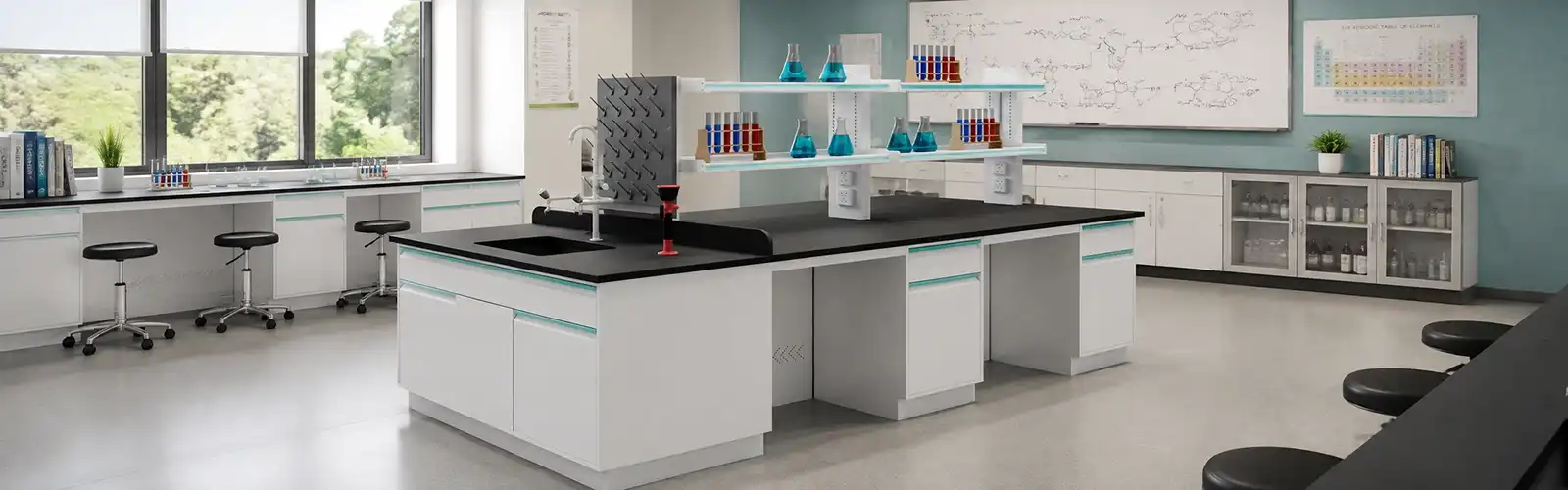
When school labs are changing all the time, lab tables for schools need furniture that can adapt to their new and complicated needs. While schools are trying to stay within their budgets, modular lab systems offer the adaptability, sturdiness, and safety features that are needed for modern STEM education. Our all-around method includes more than just supplying products. It also includes partnership during the entire planning, implementation, and operating life cycle. Engineered longevity, reconfigurable design, and full support services all work together to create long-lasting value that goes far beyond the original purchase price.
FAQ
What distinguishes professional laboratory workstations from standard classroom tables?
Professional laboratory desks have surfaces that are resistant to chemicals, stronger frames, and safety features that aren't found on regular furniture. Solid- core physicochemical boards or clay surfaces that can handle acid and alkali don't break down in our systems. The 1.00mm cold-rolled steel construction can hold more than 1,000 pounds per square foot, which is enough to support the heavy lab equipment that is common in schools. These specialized workstations are different from regular school furniture because they have integrated energy distribution and emergency safety equipment compliance.
How does modular design reduce total ownership costs?
When changing areas to fit new lessons or ways of teaching, modular systems save money on renovations. The flexible design makes facilities last longer by allowing them to adapt to changing needs without having to be replaced. Shipping costs are cut by using containers more efficiently with compact knock-down packing. Costs for ongoing service are kept to a minimum over the 20–25-year service life thanks to easy repair processes and durable building. This makes the lifetime cost benefits over traditional fixed installations very strong.
What certifications should procurement managers require?
Some important certificates are ISO9001 for quality control systems, CE marking for safety, and SEFA 8 for performance standards for laboratory chairs. The ISO14001 and ISO45001 certifications show that a company cares about the environment and workers' health. When these objective third-party checks are done, they provide a written guarantee that helps people make buying choices and meet regulatory compliance requirements.
Partner with Uken for Your Laboratory Furniture Needs
Luoyang Youken Laboratory Equipment Co., Ltd. has been in business for 30 years and has a lot of experience with teaching lab work all over the United States. As a dedicated lab table for schools provider, we know how hard it is for buying managers to find the right balance between quality, safety, and budget. Our 100 professional engineers work in a 30,000-square-meter factory that offers unique solutions backed by CE, ISO9001, ISO14001, and ISO45001 standards. We offer full turnkey support that takes away all project risk, from free site studies to installation and upkeep for life. Email Our Team at ceo@ukenlab.com to talk about how our movable lab furniture can change the way you teach.
References
1. National Science Teaching Association. (2021). Standards for Science Laboratory Safety in K-12 Schools. Arlington, VA: NSTA Press.
2. American National Standards Institute. (2020). ANSI/SEFA 8-2020: Laboratory Furniture Standard for Casework and Cabinets. Scientific Equipment and Furniture Association.
3. U.S. Department of Education, Office of Educational Technology. (2022). Future-Ready Schools: Building Technology Infrastructure for Learning. Washington, DC.
4. Architectural Research Centers Consortium. (2021). Flexible Learning Environments: Design Principles for STEM Education Facilities. Journal of Architectural Education, 75(2), 234-251.
5. National Clearinghouse for Educational Facilities. (2023). Life-Cycle Cost Analysis for Educational Facility Planning. Washington, DC: National Institute of Building Sciences.
6. Centers for Disease Control and Prevention. (2022). School Chemistry Laboratory Safety Guide. National Institute for Occupational Safety and Health Publication No. 2022-156.

CUSTOMER REVIEWS
What Our Customers Say