


Feb 6, 2025
NovaLab Tech Solutions
"Responsive and professional supplier with excellent product quality. Communication was efficient, and the entire purchasing process was smooth and reliable."


A well-designed chemical exhaust cabinet pulls contaminated air away from the operator along a controlled airflow path. It carries that air out of the building through a properly sized exhaust duct and resists the chemicals it handles through carefully chosen materials. These three elements work as one system. If airflow is unstable, the duct adds too much resistance, or the lining degrades, containment fails even when the cabinet looks sound. In this guide, I explain how each part works, which facts to check before buying, and how Uken builds its steel chemical exhaust cabinet for pharmaceutical, university, and industrial laboratories.
How a Chemical Exhaust Cabinet Works and Where It Fits
Before you compare heat flow rates or vent materials, you should all agree on what this equipment does and does not do.
There is air flow through a chemical exhaust cabinet, which is a workstation that is enclosed or mostly enclosed. It picks up vapors, fumes, gases, and aerosols during handling and sends them to an exhaust outlet. The hole in the sash lets air from the room in. The air moves across the work area and out through the exhaust connection. Because of this flow, the pressure inside the cabinet drops. This keeps contaminants from entering the room from the outside. Some of the parts that make the system work better are the exhaust connection, fan, lights, alarms, and enclosure. I always tell people who are buying something to look at all of these parts together. The form of the cabinet, the stability of the airflow, the resistance of the ducts, and the habits of the users can all change the containment.
People often mix up three different products. Most Fume Hoods have a bigger hole for doing a lot of work by hand, like showing someone how to do something. A chemical exhaust cabinet can give you a more private place to work that is only for your process. A storage cabinet with vents lets air into the containers that are kept inside. Since it wasn't made for working with chemicals, it shouldn't be used instead of the other two. When writing tests, it helps to use fume hood standards like ANSI/ASHRAE 110. Still, people who want to buy a cabinet should make sure they know which test method will work for it first. If you know what the job is, you won't have to buy the wrong tools.
Moving liquids, getting samples ready, dealing with acids and bases, pharmaceutical development, biotechnology, and quality control in industry are all made easier by chemical exhaust cabinets. You can find them in college teaching labs to keep students safe. They are used to keep things from getting contaminated in GMP production areas and environmental testing labs that work with dangerous solvents to get samples ready. Before making plans for a new building, the head of the chemistry department should look at the list of applications. This list tells you the chemical load, and the chemical load tells you what options you have for airflow, ducting, and lining. I think you should write it down before you talk to them.

After the basics are taken care of, movement is the first technical choice that needs to be made. This choice determines whether the vapors stay in the work zone.
There shouldn't be a single face-velocity number for airflow. It should change depending on the task, the chemicals present, the cabinet size, the way the work is done, and the ventilation in the building. There are many common layouts, such as front-to-back, top exhaust, rear-baffled, and custom. Internal baffles spread the air in the work area out a bit, but each one makes more noise, lowers the pressure, and uses more energy than the other ones. The capture is even, the negative pressure stays stable, and the turbulence is kept in check when the design is good. How and why are the baffle slots set up the way they are? Ask the person who made it. An honest answer shows that the people who designed it thought about your chemicals and didn't just copy a standard plan.
Cross-drafts are caused by things like doors, windows, supply air diffusers, walkways, and equipment close by. These can pull contaminants and other things out through the opening. As someone walks by, they can mess up the capture. I think the chemical exhaust cabinet should be put away from doors and paths of travel. After setting up the room's HVAC system, check the airflow. Monitoring matters just as much. There are alarms and sash signs that let people know when containment drops. As per OSHA's Laboratory Standard (29 CFR 1910.1450), there must be a Chemical Hygiene Plan that checks fume hoods and other similar controls to make sure they are still working right. An alarm that can be seen helps with this job.
In the purchase order, write down the terms of acceptance, test methods, airflow goals, and alarm features before the production starts. In ANSI/ASHRAE 110, tracer gas, smoke visualization, and face-velocity measurement are used to check how well fume hoods keep fumes inside. The EHS offices at universities often need these kinds of test reports from outside sources. This rule is meant to be used for fume hoods, so talk to your engineer about how it will work with a cabinet. Once everyone has agreed on the numbers, check them for noise, sash operation, airflow, uniformity, static pressure, and alarms when the system is turned on for the first time. It also stops debate at the acceptance stage, where faculty judges might question the results, when the standards are clear.
The cabinet should be balanced, but that doesn't matter if the duct behind it can't move enough air.
Ducted systems get rid of contaminated air all the time and are good for dangerous or changing chemical work. Systems that don't use ducts clean the air and bring it back into the room. So, they need filters that work with the chemicals and records of when they were used and when they need to be replaced. In a lab that uses a lot of different chemicals or that changes its methods all the time, a filter might not catch all the vapors. That means air flow is the better choice. If you don't have access to building air, ductless units are easy to set up. However, I would only use them for chemicals that are on a known, short list. Write down your choice in your risk assessment no matter what you do.
The duct needs to be able to handle the chemicals, temperature, moisture, UV rays, fire safety rules, and mechanical stress at the site. It can handle many acids and bases, but it also burns, which is why we need new fire codes. As long as they don't get too hot, thermoplastics made from PVC can handle many streams that are acidic. Stainless steel can handle heat and physical stress, but common types can be hurt by fumes that contain chlorides, such as hydrochloric acid. As long as the treatment is right for the job, coated metals will work. The material should match the exhaust stream. Talk to the building engineer to make sure of this. NFPA 45 talks about fire safety in chemistry labs, so check the different duct options against that rule.
The duct tells you if a cabinet sends the right amount of air to the site. You can tell how much air is lost in a duct by its length, width, bends, transitions, dampers, and ends. There is friction loss at every part, and it goes up quickly as the air speed goes up. When lines are too small, they make more noise and put more stress on the fans. Getting the outlet connection on the cabinet to match the duct width on the building as soon as possible is important, since adapters add loss. While the system is being set up, check the airflow, static pressure, alarms, and discharge safety. So that exhausted vapors do not come back into the building, move the point of release away from paths and air openings. A lot of people get these kinds of estimates from the ACGIH Industrial Ventilation Manual.
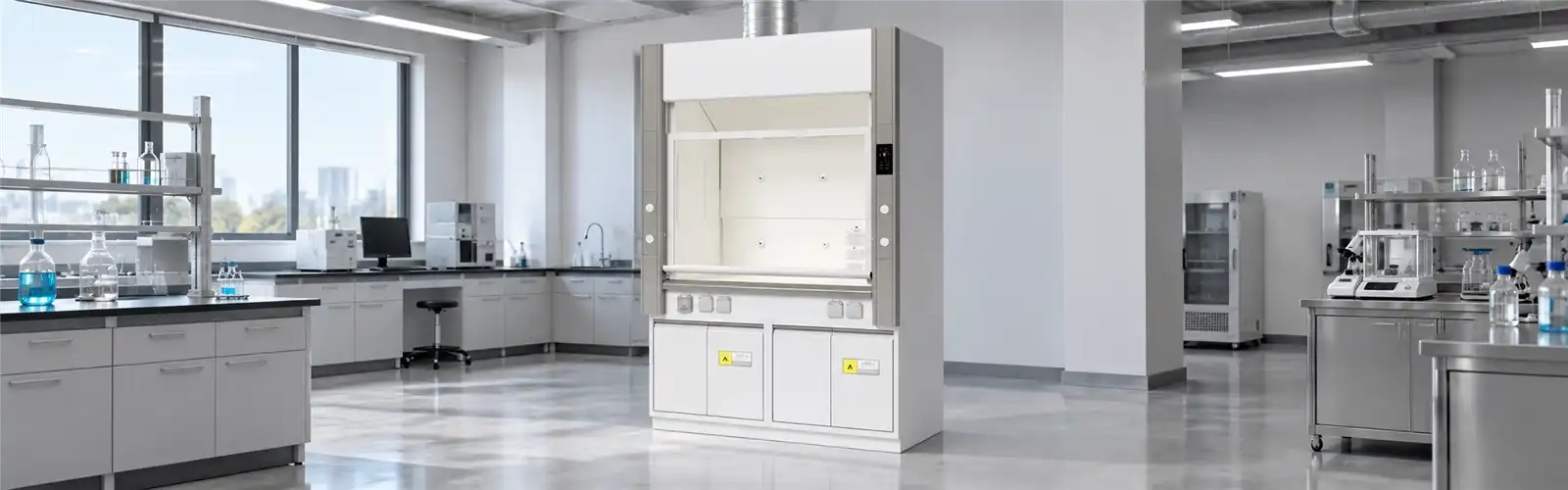
Flow of air and vents keep the person using it safe, and the materials decide how long the cabinet can work.
A label that says "chemical-resistant" doesn't tell you much. Write down a list of all the chemicals, along with their amounts, temperatures, exposure times, mixes, and humidity. Then, match each part to the door, the drawer, the worktop, the glass, the gaskets, the hinges, and the screws. Small parts break first most of the time. A weak gasket or a hinge that has rusted can ruin a cabinet that is otherwise fine. Some of the things that can be used are powder-coated steel, stainless steel, polypropylene, PVC-based panels, composites, and epoxy resin.
The steel plate layer in a Uken chemical exhaust cabinet is at least 1 mm thick. The steel plate is laser cut and welded to make the cabinet strong, stable, and resistant to impact. The provider should be asked for this information instead of making general claims. The approved list of materials should also be kept in the project file. There are two steps that panels go through before they are covered with an epoxy powder that is at least 70 μm thick and can handle both acids and alkalis. This order is important because it helps the coating stick to the metal if you treat the surface first. Its strong frame can also hold heavy things, like a lot of reagent bottles and analysis tools, without bowing. In the end, the body is made to be able to handle being around strong chemicals over and over again in a lab.
Inside, there is a 5 mm board that is antibacterial or something else that won't rust. The surface is perfect and smooth. Chemicals can't get through and there are no cracks for trash to get into. A stable lifting system makes it easy to move the sash, and the hardened glass window has rubber buffers on the edges. Model A is 1200 mm long, Model B is 1500 mm long, and Model C is 1800 mm long. The width is 850 mm and the height is 2350 mm for all three sizes. Uken follows the quality rules set by SGS, CE, ISO, and SEFA. With their OEM/ODM service, customers can change their products' size, color, and how they work.
Care must still be taken to make and keep a good plan, which should come from a company that keeps track of the work.
In order to figure out the level of risk, you should look at things like how volatile, poisonous, flammable, corrosive, reactive, hot, and how much dust and aerosols it makes. Next, look for low-airflow alarms, sash stops, parts that won't rust, the right electrical parts, safe lighting, and spill control. When it comes to the US, labs follow OSHA's Laboratory Standard, NFPA 45, and the EHS rules set by their own university. There are different rules in each state and area. Engineers and authorities in the area are in charge of making sure everything is legal, even if the supplier gives them technical data and paperwork like Uken's CAD drawings and material certifications. Reading Prudent Practices in the Laboratory to learn more about the background is helpful for the risk review.
Before the delivery, check the floor space, ceiling height, entry paths, floors that can hold weight, electrical capacity, exhaust connections, HVAC balance, drains, and utilities. Write down who is in charge of each task. After connecting everything, compare the noise level, airflow, static pressure, sash function, alarms, and lights to the list provided in the purchase order. Every day, workers look for smells, airflow, sash movement, rust that can be seen, plugged baffles, and spills. Using the right cleaners, checking the seals and glass, trying the warning, and going over the fan and ducts are all parts of regular upkeep. Keeping a written record of maintenance helps with budgets, audits, and making plans for when to replace things.
Most people make the mistake of buying something based only on price or size, approving materials without seeing the full list of chemicals, or not checking to see how much airflow the building's exhaust system can handle. After a while, it's tough to deal with vague words like acceptance, airflow, and noise. To keep track of the total cost of ownership, you should add up the costs of setup, energy, repairs, spare parts, and downtime. When you look at different sources, you should ask for parts lists, models, data on airflow, information on how well the products work together, quality records, and information on warranties. Buyers from stores and OEMs should also check to see if the product can be privately labeled and if it matches what they've ordered before. Before you place an order, check the site to make sure there are no problems.
The materials, airflow, and ventilation must all work together in a chemical exhaust cabinet for it to do its job well. Airflow should be based on the job and be proven by agreed-upon tests. Cross-drafts should be handled and alarms should be set up. Ducts must carry the required volume without too much resistance, be made of materials that work with the exhaust stream, and safely empty. All of the materials, even small ones like gaskets and hinges, must match the full chemical profile. The finished cabinet is made of steel that has been cleaned, has a thick epoxy powder coating, and has a smooth, corrosion-resistant lining. Safety checks, planning the installation, regular maintenance, and a careful review of the supplier ensure that the performance stays the same over the life of the cabinet.

Not at all. A fume hood generally has a bigger opening for general physical work, while a chemical exhaust cabinet can provide a more protected area for a particular process. The choice should be based on a risk assessment.
When the chemicals change, the risks are high, or you need to keep taking them out, choose ducting. Ductless units can only handle a few chemicals, and the filters need to be changed and kept an eye on.
You agree with the way it's written in the purchase order. Read ANSI/ASHRAE 110 to learn more about fume hoods. When you turn on the system for the first time, check the airflow speed, uniformity, static pressure, and alarms.
Please let us know the size of the cabinet, the chemicals or safety data sheets that will be used, the application, the airflow targets, the route of the duct, the chosen materials, the amount, the location of transport, and any documentation needs.
The company Uken makes chemical exhaust cabinets and has 100 professional engineers on staff. They can do OEM/ODM customization and make sure their products meet ISO, CE, SEFA, and SGS quality standards. Send an email to service@ukenlab.com with a list of your chemicals, the size of your cabinet, and details about your pipes. You can also text us at +8615102909133. We'll look over your project and give you advice on how to set it up. Go to ukenlab.com to learn more about the product.
1. ANSI/ASHRAE Standard 110, Method of Testing Performance of Laboratory Fume Hoods, 2016
2. NFPA 45, Standard on Fire Protection for Laboratories Using Chemicals, 2022
3. Prudent Practices in the Laboratory: Handling and Management of Chemical Hazards, National Research Council, 2011
4. OSHA Laboratory Safety Guidance (OSHA 3404), 2011
5. Industrial Ventilation: A Manual of Recommended Practice for Design, ACGIH, 2019
6. ANSI/AIHA Z9.5, Laboratory Ventilation, 2012