


Feb 6, 2025
NovaLab Tech Solutions
"Responsive and professional supplier with excellent product quality. Communication was efficient, and the entire purchasing process was smooth and reliable."


If you're in procurement or oversee lab equipment sourcing, you've likely asked yourself this issue at least once: should this lab employ a fume hood or a biosafety cabinet? At first glance, they seem identical, but the incorrect choice might put staff at risk and cause compliance difficulties. A laboratory fume hood is a local exhaust ventilation device designed to confine chemical vapors and divert them away from the user. A biosafety cabinet, in contrast, utilizes HEPA filtration to shield the operator and biological samples from cross-contamination. The first step to making a solid purchase choice is to understand the difference.
What Are Laboratory Fume Hoods and Biosafety Cabinets?Defining the Chemical Fume Hood
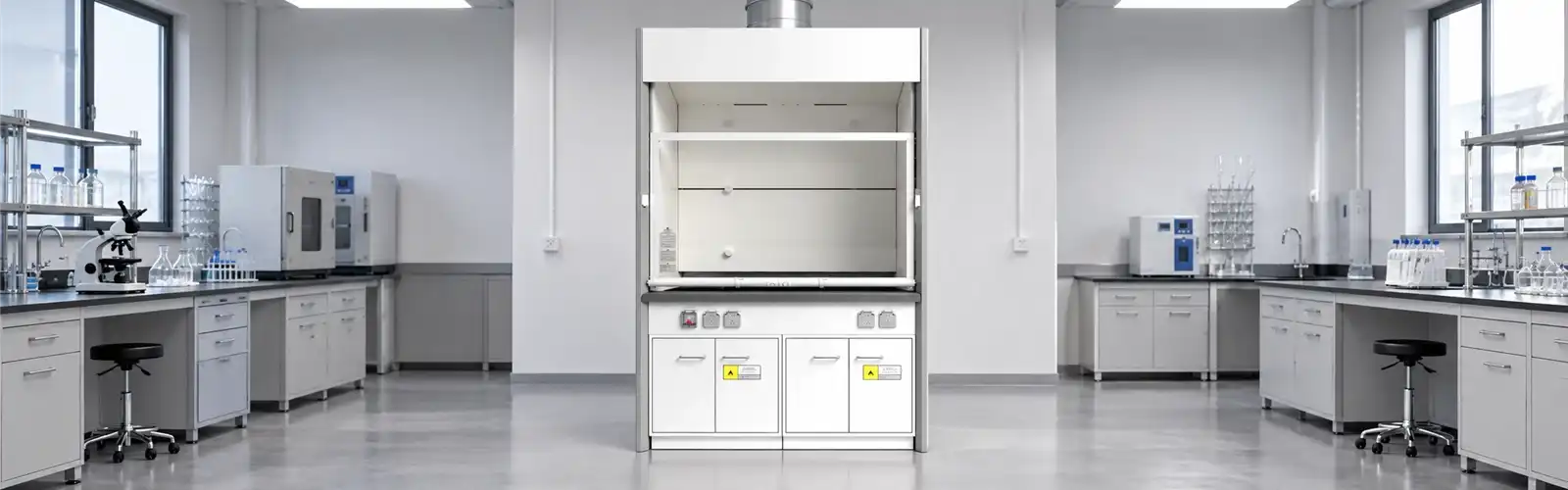
A chemical fume hood has ducts that bring air from the room to the work area and out of the building. It is the primary technological protection against VOCs (volatile organic compounds), acid mists, and combustible vapors. OSHA 29 CFR 1910.1450 states that laboratories that work with dangerous chemicals should have fume hoods in place to ensure the health and safety of the lab workers. The exhaust air is not filtered but blown outdoors.
In the biosafety box (BSC), the air may be recirculated or exhausted via HEPA filters that filter 99.97% of particles 0.3 µm or less in size. NSF/ANSI 49 classifies BSCs into three classes: Class I (just protecting the personnel), Class II (protecting the samples, staff, and environment), and Class III (providing the maximum level of protection for BSL-4 pathogens). They are meant to work with biological agents, cell cultures, and illnesses, not chemical vapors.
Mix these two items and bad things will happen. Standard BSCs are not designed for organic solvent fumes, and carbon-based compounds may damage HEPA filters and increase fire hazards. But a ducted fume hood won’t keep the environment clean enough for cell operations or safeguard the samples. Make sure you know what protection mode a lab requires before you put your order in so that you don't have to spend a lot of money for replacements or get in trouble with the law.
At about 80 to 100 fpm (0.4 to 0.5 m/s), a fume hood fan pulls air in through the open sash and sends it out the door and through the open sash. A BSC uses a laminar airflow pattern to keep the area clean. This design moves air either down over the work surface or through a mix of supply and exhaust HEPA filters. Different goals are set for each system when it comes to containment.
Laboratory fume hoods get rid of all the air, so the waste stream doesn't go through any pads. The BSCs depend on how well the HEPA screens work. A HEPA filter filters out 30% of the air that leaves a Class II Type A2 cabinet, and 70% of the air that stays in the cabinet is cleaned. This means that a BSC can work in a room that doesn't have any outside venting. On the other hand, a ducted fume hood needs to be hooked up to the exhaust system of the building. For a clear picture of what each device protects, here it is:
People and the environment are safe with a Class I BSC, but the sample is still open to air pollution.
For any job that includes acid digestion, liquid evaporation, chemical preparation, or making organic molecules, you need a fume hood. Chemical hygiene plans from OSHA and NFPA 45 say that these jobs need to have planned air controls. In this group are pharmaceutical R&D labs that make active ingredients and educational labs that teach general chemistry.
Any work with BSL-1 to BSL-3 agents must be done by a certified BSC. This includes cell culture, viral assays, microbial work, and procedures that use these agents. It is written in NSF/ANSI 49 describes how to test a cabinet, and most university biosafety groups need a trained technician to certify the cabinet every year. A normal fume hood doesn't belong here.
In some labs, they work with biohazards or biological samples that are chemically protected and don't let out a lot of air. In this case, a Class II Type B2 BSC that uses HEPA to clear the air outside might be able to meet both chemical and biological containment guidelines. But building engineers need to make sure that each agent is allowed to be used.

Just how much air a fume hood lets out is directly linked to how much it costs to run. All year long, a constant air volume (CAV) hood can use a lot of HVAC power. Variable air volume (VAV) types use less energy because they change the flow of air based on where the window is placed. The BSCs don't have a big impact on HVAC systems, but every year their HEPA filters need to be replaced and their NSF/ANSI 49 approval needs to be renewed. This adds to the cost of ongoing service.
There is no way for dealers and wholesalers to avoid writing up licenses. End users in the government, education, and pharmaceutical fields need proof of compliance before they will accept delivery. The lab fume hoods made by Uken are made of steel and are approved by CE, ISO, and CQC. People who sell things on other sites now have all the paperwork they need to quickly finish sales in markets that are regulated.
In general, Uken laboratory fume hoods come in three sizes: L1200×D850×H2350mm, L1500×D850×H2350mm, and L1800×D850×H2350mm. These sizes are good for most labs in the school, pharmaceutical, and chemistry fields. It is made of all steel and has precise laser-cut parts that make sure that all the units fit together perfectly. Tests show that steel sheets are strong enough to hold weight and take hits, so pieces are ready to be put together when they arrive. Long-distance shipping is safer for each unit when it is packed in standard export packaging. This saves distributors money on damage claims and rework costs.
Fume hoods should be located away from doors, air supply diffusers, and busy paths to avoid reducing airflow. ASHRAE 110 requires that the hood undergo commissioning tests that include tests to verify containment of tracer gases inside the hood. ASTM F149 requires BSCs to be located away from HVAC vents and to be authorized on-site after installation.
Both devices should be examined from time to time to make sure they continue to operate properly. Check the face velocity of fume hoods once a year using a calibrated anemometer to ensure that the airflow is operating correctly. For BSCs, the HEPA filter should be examined annually or at the time of replacement. Also check the sash seals, blower belts, and exhaust connections on fume hoods.
Important to keep in mind that while a laboratory fume hood and a biosafety box are both necessary in the laboratory, the two are not interchangeable given their purposes. This is because the two different parts of the equipment cannot be substituted for each other. That is the reason for this. That’s why this is the case. This situation has occurred, and it means that it is just not feasible to substitute one of them for the other.
No. Standard BSCs are not rated for flammable or toxic chemical vapors. Carbon-based solvents can saturate HEPA filters and create fire risks. Only a ducted fume hood or a specially designed chemical BSC should handle volatile chemicals.
OSHA and ASHRAE recommend annual face velocity testing at minimum. Testing is also required after the hood is relocated, repaired, or following any significant HVAC change in the building.
For most international resale markets, CE, ISO, and CQC certifications cover core compliance requirements. For North American institutional clients, SEFA 1 and ASHRAE 110 test reports add credibility during procurement approval processes.
Most manufacturers and safety guidelines recommend an 18-inch (approximately 457 mm) sash opening as the optimal working height, balancing containment performance with user access.
VAV models cost more upfront but significantly reduce building HVAC energy consumption. For clients operating multiple hoods continuously, the energy savings typically offset the price difference within two to three years.
Due to the fact that this particular group is the first organization that each and every one of us needs to be acquainted with, it is of the utmost importance that we start conversations about it. In this context, the organization that has to be mentioned is the American Society of Heating, Refrigerating, and Air Conditioning Engineers. In accordance with Standard 110-2016, which was developed by the American Society of Heating, Refrigeration, and Air Conditioning Engineers (ASHRAE), there is a technique that can be used in order to assess the effectiveness of laboratory fume hoods in labs. This approach is in accordance with the standard. This specific version of the ASHRAE standard was put out for publishing in the year 2016, which was the year in question. To talk about your wants, you can email us at service@ukenlab.com, or call us on WhatsApp at +86 15102909133.
1. American Society of Heating, Refrigerating and Air-Conditioning Engineers. ASHRAE Standard 110-2016: Method of Testing Performance of Laboratory Fume Hoods. ASHRAE, 2016.
2. NSF International. NSF/ANSI 49: Biosafety Cabinetry: Design, Construction, Performance, and Field Certification. NSF International, 2019.
3. Occupational Safety and Health Administration. OSHA Laboratory Standard: 29 CFR 1910.1450 – Occupational Exposure to Hazardous Chemicals in Laboratories. U.S. Department of Labor, 2011.
4. National Fire Protection Association. NFPA 45: Standard on Fire Protection for Laboratories Using Chemicals. NFPA, 2019.
5. Scientific Equipment and Furniture Association. SEFA 1: Laboratory Fume Hoods – Recommended Practices. SEFA, 2021.
6. DiBerardinis, L. J., et al. Guidelines for Laboratory Design: Health, Safety, and Environmental Considerations. Wiley, 2013.