


Feb 6, 2025
NovaLab Tech Solutions
"Responsive and professional supplier with excellent product quality. Communication was efficient, and the entire purchasing process was smooth and reliable."


A laboratory fume hood is a local exhaust ventilation device that protects researchers from hazardous vapors, chemical fogs, and airborne particles by removing contaminated air from the breathing zone and expelling it safely outside the facility. If you operate a pharmaceutical laboratory, university teaching space, or chemical research unit, choosing the proper fume hood has a direct impact on staff safety and regulatory compliance. This tutorial will provide you with the basics of what they do, how they are used in real life, how to choose one, and what you need to know to purchase with confidence.
Understanding Laboratory Fume Hoods: Features and FunctionalityWhat a Fume Hood Actually Does
A fume hood is a negative-pressure containment for chemical operations. Air enters the sash opening in the front, moves over the work surface, and departs via the exhaust duct. The face velocity is generally 60 to 100 feet per minute (0.3–0.5 m/sec) according to guidelines from ASHRAE 110, controlling the unit’s ability to collect volatile organic compounds (VOCs) and acid mists before reaching the user.
There are two basic types, ducted and ductless (recirculating) units. The all-steel units from Uken are suitable for broad chemical activity; the ducted units discharge the air straight outside the structure. Ductless variants purify air using activated carbon or HEPA filters before returning it to the room and are suitable for light-duty applications but cannot handle high-volume solvent activity. Chemical fume hoods are not interchangeable with biosafety cabinets, which are a different product category used for biological substances.
In addition to airflow metrics, three design features differentiate excellent units from middling ones. First, the adjustable back baffle system equalizes the distribution of airflow across the whole working height, catching both heavy vapors at the base and hot gases toward the top. Second, an aerodynamic airfoil at the sash sill lowers turbulence at the hood face, identified by SEFA 1 criteria as a key containment risk. Third, an auto-hanging sash system allows the operator to swiftly replace the sash without disturbing productivity.
The chemical and pharmaceutical laboratories account for the highest percentage of laboratory fume hood installations worldwide. Consistent airflow control is required for drug manufacturing, active pharmaceutical ingredient (API) handling, and formulation activities. Educational labs are another big chunk – students practicing titration or distillation, for example, benefit from a forgiving safety environment, with the ventilation system providing constant protection against unskilled methods.
For research and development teams dealing with new or poorly defined chemicals, reliable containment is a need, since exposure limits for new substances are frequently not known. Biological laboratories working with volatile fixatives such as formaldehyde also use fume hoods, but these laboratories also use extra biosafety equipment.
According to OSHA 29 CFR 1910.1450, laboratories must provide engineering controls as the primary method of limiting chemical exposure. A properly maintained fume hood meets this requirement directly. Here are the core protection benefits these units deliver:
These protection layers work together to bring labs into compliance with chemical hygiene plan requirements while reducing insurance and liability exposure for facility operators.

Standard width options—1200 mm, 1500 mm, and 1800 mm—cover the vast majority of laboratory bench configurations. A 1200 mm unit suits single-user, single-process tasks. A 1500 mm unit is the most common choice for general research. An 1800 mm unit accommodates two simultaneous users or larger apparatus setups. Confirm ceiling height clearance before ordering; the total unit height for Uken's three standard models is 2350 mm.
For procurement teams supplying labs in regulated industries, certification documents are non-negotiable. CE certification confirms compliance with European safety directives. ISO certification reflects consistent manufacturing quality control. CQC certification meets Chinese national standards, which matters for domestic resale and regional export markets across Southeast Asia and the Middle East. Uken's laboratory fume hoods carry all three, and full documentation packages are available upon request—a practical advantage when your customer needs to pass a facility inspection quickly.
All-steel construction is the benchmark for durability in demanding environments. Precision laser cutting produces tight component tolerances, which means better seal integrity and more consistent airflow. Steel sheets rated for high load-bearing capacity and impact resistance keep the unit structurally sound under heavy equipment loads and the occasional accidental collision. Every weld joint should pass a quality inspection; this structural attention directly extends service life.
Wash internal lining regularly with mild detergent. Monthly: examine the sash for chips or cracks in the safety glass. Check the rear baffle holes for chemical deposits that might block airflow. Immediately replace rusted fittings. Corrosion on steel parts means the coating has failed and must be fixed before it gets worse.
OSHA and ASHRAE require professional certification at least annually or promptly after a unit transfer or repair. Face velocity testing is based on measurements of airflow at various places across the sash opening using a calibrated anemometer. If the measurement is less than 60 fpm, the device is no longer providing proper confinement. For high-risk applications, ASHRAE 110 tracer gas testing offers a more stringent containment evaluation.
Third-party certification by a qualified industrial hygienist offers the recorded evidence required by regulatory bodies and insurance underwriters. Auditors normally want to see at least 3 years of testing history, so keep all test records on file.
If you are purchasing fume hoods in bulk, the manufacturing capacity and lead time are as important as the unit pricing. Uken has a 50,000 m2 manufacturing facility with 100 engineers to ensure constant output on standard 1200/1500/1800 mm units. Transit damage claims are a serious cost problem when resale margins are small. Standardized export packing for long-distance transportation helps.
The exhaust connection is installed professionally to the specified face velocity. A poorly fitted duct connection may lower airflow by 20-30% and affect safety performance from the moment of installation. Uken offers full installation paperwork and technical standards to help distributors, allowing regional engineering firms to make the connection without factory interference.
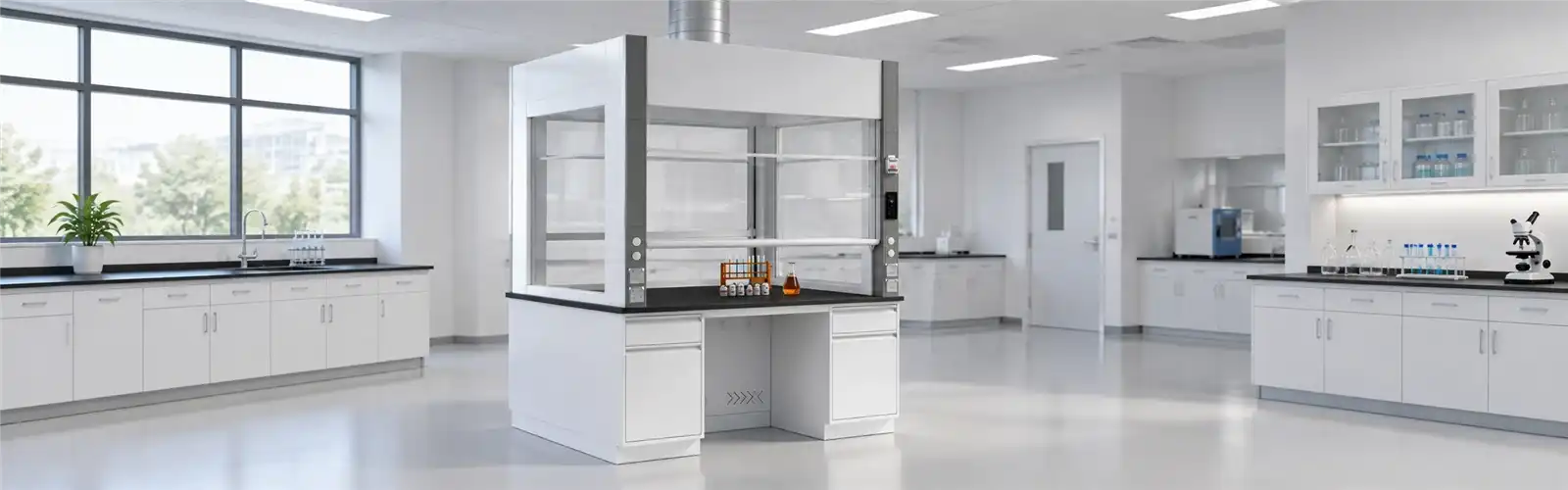
Selecting the proper laboratory fume hood depends on the airflow performance, build quality, and certification credentials aligned to your unique application. All steel structure with precise laser-cut components offers the structural stability needed in demanding scientific conditions. Standard sizing means that it is easier for distributors to stock up on rapidly moving stock. CE, ISO, and CQC certifications reduce friction at the point of resale. Annual face velocity testing and normal maintenance maintain the unit operating as specified throughout its service life.
A ducted unit exhausts air outside the building and handles a wide range of chemicals, including concentrated solvents and acids. A ductless unit filters air through activated carbon and returns it to the room; it suits light-duty tasks but cannot handle high-solvent loads safely.
OSHA and ASHRAE standards require professional certification at least once a year. Recertification is also required after the unit is relocated or serviced.
No. A standard fume hood protects the user from chemical exposure but does not provide sterile conditions or HEPA filtration. Biological agents require a biosafety cabinet designed specifically for that purpose.
Acceptable face velocity falls between 60 and 100 fpm (0.3–0.5 m/s) at the sash working height. Readings below 60 fpm indicate inadequate containment.
The optimal sash working height—typically 18 inches—balances containment performance with user access. Leaving the sash fully open reduces face velocity and compromises the containment barrier.
Uken's laboratory fume hood supplier program offers CE-, ISO-, and CQC-certified units in three standard dimensions, with volume pricing, full documentation packages, and export-ready packaging. Contact Our Team directly to discuss your stock requirements or request a product specification sheet. Reach us at service@ukenlab.com to WhatsApp: +8615102909133 start your inquiry.
1. American Society of Heating, Refrigerating and Air-Conditioning Engineers. ASHRAE 110: Method of Testing Performance of Laboratory Fume Hoods. ASHRAE, 2016.
2. Occupational Safety and Health Administration. Occupational Exposure to Hazardous Chemicals in Laboratories (29 CFR 1910.1450). U.S. Department of Labor, 2011.
3. Scientific Equipment and Furniture Association. SEFA 1: Fume Hoods, Recommended Practices. SEFA, 2010.
4. National Fire Protection Association. NFPA 45: Standard on Fire Protection for Laboratories Using Chemicals. NFPA, 2019.
5. American Industrial Hygiene Association. Laboratory Ventilation: A Practical Guide. AIHA Press, 2003.
6. Prudent Practices in the Laboratory: Handling and Management of Chemical Hazards. National Academies of Sciences, Engineering, and Medicine. National Academies Press, 2011.