


Feb 6, 2025
NovaLab Tech Solutions
"Responsive and professional supplier with excellent product quality. Communication was efficient, and the entire purchasing process was smooth and reliable."


A laboratory exhaust cabinet is a ventilated cabinet that catches and eliminates fumes, vapors, dust and odors at the source via building ductwork. They are made from coated steel, stainless steel, polypropylene, or PVC and there are two major variants, ducted and ductless units. Each variety is suited to varied chemical loads, room layouts, and budgets. These cabinets can be found in pharmaceutical, hospital, school and industrial labs protecting staff during weighing, mixing and solvent work. In the US the same equipment is generally called fume hood, so I use both terms in this article.
Room air enters through the front hole, sweeps across the work surface, and transports impurities to the back baffles. The baffles break the air up into slots so it flows uniformly and there are rarely dead spots. The air then rises into the plenum and is ducted to an exhaust fan and a discharge point above the roof. Because the cabinet is pulling air out of the space, the lab needs make-up air to compensate. If no replacement air is available, the room is under negative pressure and the capture at the aperture is reduced.
Face velocity is the speed of the air passing through the open face and is measured in feet per minute (fpm). Historically, many U.S. facilities have targeted 80 to 120 fpm; low-flow designs target lower and demonstrate containment through ASHRAE 110 testing. Higher speed doesn't always guarantee safer labor. Fast-moving air causes turbulence which can attract vapors toward the operator. Heat from equipment inside, cross drafts from doors, supply diffusers and people walking by also disrupt the flow. If the fan speed remains constant then a lower sash increases the velocity. I use face velocity as a first approximation and then always check results with a confinement test.
The amount of static the fan will have to overcome will depend on duct material , diameter and route . Long lengths, sharp elbows and undersized ducts create resistance and reduce airflow to the cabinet. Don’t just size the fan to the rated volume of the cabinet, size it for the entire system loss. Provide access for inspection along the duct so that technicians can inspect dampers and flexible connectors later. Corrosive fumes require duct materials that can handle the chemicals being used. EPC contractors should also coordinate exhaust volumes with the HVAC designer early on since having numerous cabinets on one fan can change the airflow when a user opens or shuts a sash.
Ducted cabinets are vented to the outside of the building. They are good for repeated use, pungent fumes, unknown chemical combinations, processes that produce heat. Ductless units filter the air with carbon or other filters and return the air to the room. They are good for limited, well-defined, lower-risk operations and require filter monitoring and regular replacement, since saturated media will release vapors back into the space. Ductless devices save on ducting, and are readily moved. But a filter will only pick up the chemicals it was selected for. I would suggest a recorded chemical review before selecting one. For high-volume or harmful operations the standard solution remains a ducted unit.
And coated steel, stainless steel, polypropylene and PVC each tackle various challenges. Coated steel is strong and an excellent bargain for general chemistry. Stainless steel handles heat and frequent washing. Polypropylene and PVC withstand acids that destroy metal, which is good for acid digestion activities. Configuration is important too. Benchtop units minimize floor space. Floor-mounted and walk-in units carry tall apparatus and huge setups. Equipment-integrated designs surround one instrument.Select based on chemical compatibility, temperature, cleaning requirements, and size of device. When specifying a laboratory exhaust cabinet, also verify that the ceiling height and duct route allow proper installation.
These cabinets are used by pharmaceutical teams for dilution, sample preparation and solvent cleaning in the vicinity of active chemicals. Chemical and materials labs support corrosion testing, coating development, battery research, and polymer or adhesive evaluation. Hospital laboratories prepare reagents and collect chemical wastes. Schools, Universities install a number of equipment for student experiments where sturdy sashes and easy operation is important. Match cabinet size, airflow, material, and monitoring to the magnitude and hazard of the process. A chemical exhaust cabinet is not a substitute for a biosafety cabinet, thus labs working with biological agents require a certified biosafety cabinet or an isolator.
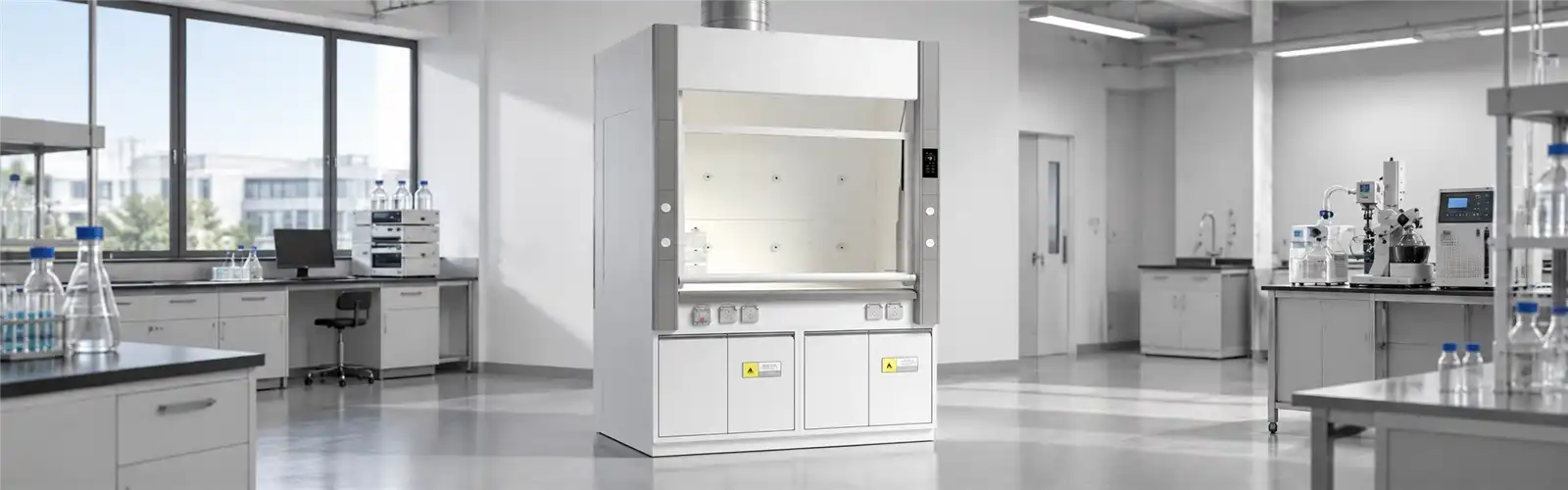
The two terms are overlapping. In the US, a "fume hood" is an open-front ducted enclosure to shield the operator from chemical vapors. The standard phrase in British English and international tenders for the same type of equipment is laboratory exhaust cabinet. In some projects it is also used for an enclosure created around a single process or instrument. Read the drawing and the spec, not the label. Look at the opening size, airflow target, liner material, and test standard. These are what determine the performance, not the name.
Biosafety cabinets filter air with HEPA filters to safeguard samples and/or personnel from biological agents. Solvent vapors can destroy filters and some types recirculate air back into the room, thus they are not intended for volatile or corrosive chemicals. Fume Hoods and exhaust cabinets suck air out through ducts and do not provide a sterile work zone, so they are not suitable for protecting cell cultures. If your lab works with both, plan on distinct equipment for each. Consult with your biosafety officer before you finalize the scheme.
Ventilated chemical storage cabinets are designed to store containers, however they do not provide a work area for open procedures. Air is filtered in the clean benches, which would blow fumes right into your face. Local exhaust arms capture emissions from a small point source like one instrument, but have no containment and a short capture range. I will use a simple rule. Use an exhaust cabinet or fume hood for open chemical handling, an extraction arm for light point sources and a storage cabinet for resting containers.
Safe operation begins with a sash or door that slides easily and stays where you put it. Airflow gages, pressure sensors and alarms advise users of exhaust decreases. Calibrate these devices on a timetable and put a label that shows the approved sash functioning height. Keep equipment and containers at least six inches from the sash plane. Objects close to the front edge interfere with the airflow. Do not put large machinery on the front sill. Hardware protects humans as much as good user practices do.
Control of ignition sources, static discharge and electrical equipment in the work area is required for flammable vapors. NFPA 45 establishes fire prevention criteria for chemical laboratories. Ensure that liners, baffles and sealants are resistant to the chemicals you intend to employ as chemical attack reduces service life and can discharge particles. Ensure there is a spill containment plan and a way to collect waste, as well as current safety data sheets next to the cabinet. Never utilize the working area for bulk storage. The clutter jams the baffle slots and disturbs the airflow pattern.
The most referenced standards for US projects include OSHA’s Laboratory Standard (29 CFR 1910.1450), ANSI/ASSP Z9.5 for laboratory ventilation, NFPA 45 and ASHRAE 110 for containment testing. European projects employ EN 14175. Furniture makers use SEFA 1 suggested methods. Ask the provider for factory inspection documents and arrange for an on-site performance test following installation. Retest every year and after every move, repair or alteration to the exhaust system. “Each report should be kept in the project file for audits and handover.
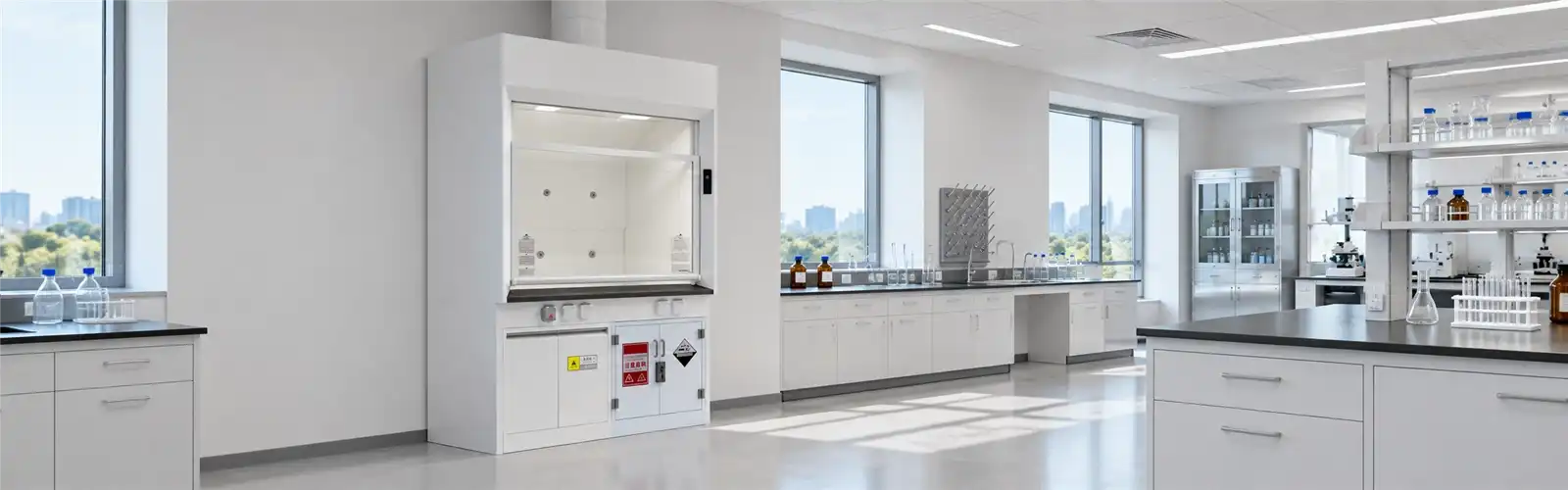
First list your chemicals, amounts, temperatures, how often users will be working in the cabinet and the main hazards. Then, select a suitable laboratory exhaust cabinet by comparing ducted or ductless designs, size, access style, materials and controls. Compare ventilation, confinement, noise, energy use, and the static pressure availability of your building. Look at warranties, replacement parts, documentation and supplier’s track record on abroad projects. Lead time is important on EPC schedules so get production and delivery deadlines in writing before you commit.
Luoyang Youken Laboratory Equipment Co., Ltd. Their lab exhaust cabinet is made of all-steel panels with a minimum thickness of 1.0 mm, with laser cutting for tight joins. Each shell is pickled and phosphated before an epoxy powder coating of at least 70 microns. Inside, the cabinet is lined with 5 mm of antibacterial board, and the airflow is guided by corrosion-resistant baffles. The tempered glass pane is equipped with rubber buffers and runs on a synchronous belt lift for smooth, distortion-free movement. It is offered in three variants, 1200, 1500 and 1800 mm long, 850 mm deep and 2350 mm high. Uken goods are up to ISO, CE, SEFA and SGS requirements. 100 engineers support design works.
Price is based on size, material, ducted installation, fan capacity, filtration, controls, customization, testing, packaging and delivery. Don’t just compare cabinet pricing – compare overall project cost. Uken’s modular design makes it easy to construct and disassemble, and its compact packaging keeps shipping costs low. Each cabinet is protected for ocean transit with reinforced crates, corner guards, moisture barriers and internal bracing. EPC contractors and system integrators can submit drawings for modifications and request OEM branding. Submit your chemical data, layout, utilities and standards and we will offer the appropriate design for your project.
Protects humans by removing toxins at the source, then exhausting them through ducts or filters. A laboratory exhaust cabinet. Performance is a function of the airflow path, face velocity, duct design, make-up air and user behaviors, thus a containment test is more important than a product label. Ducted units are good for frequent, high danger work while ductless units are good for narrow, low risk work. The choice of material should be governed by the chemicals to be used. Exhaust cabinets and fume hoods are for open chemical work. They are not biosafety cabinets, storage cabinets or extraction arms. Fire controls, chemical compatibility and testing against OSHA, NFPA, ASHRAE, ANSI/ASSP and EN or SEFA references also contribute to safe use. Buyers do better when they define the process up front and compare total project cost.
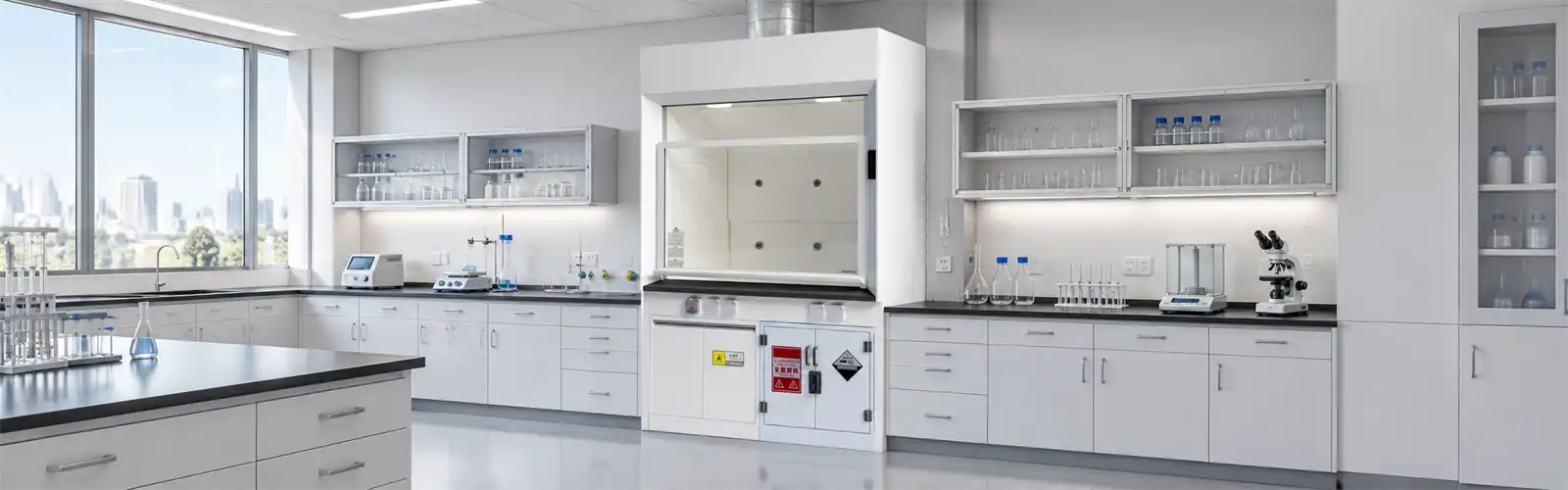
In most US projects, yes. Both names describe a ducted enclosure that removes chemical vapors from the work zone. Check the specification for opening size, liner material, airflow target, and test standard.
Only for limited, low-risk tasks with filters matched to the chemicals. Filters saturate over time and need monitoring. Strong vapors, toxic materials, and unknown mixtures call for a ducted unit.
Uken supplies 1200, 1500, and 1800 mm models, each 850 mm deep and 2350 mm high, with a shell of at least 1.0 mm steel and a coating of at least 70 μm. Contact Us about custom requirements.
Looking for a laboratory exhaust cabinet manufacturer who can work from your drawings? Uken supplies steel cabinets in 1200, 1500, and 1800 mm sizes with ISO, CE, SEFA, and SGS credentials. Send your chemical list, layout, and standards to service@ukenlab.com or message WhatsApp +8615102909133. Our engineers will reply with a project-specific recommendation and quotation. Visit ukenlab.com for more details.
Prudent Practices in the Laboratory: Handling and Management of Chemical Hazards, National Research Council, 2011
ANSI/ASHRAE Standard 110, Method of Testing Performance of Laboratory Fume Hoods, 2016
OSHA Laboratory Safety Guidance, Occupational Safety and Health Administration, 2011
NFPA 45, Standard on Fire Protection for Laboratories Using Chemicals, National Fire Protection Association, 2019
EN 14175, Fume Cupboards, European Committee for Standardization, 2003
ANSI/ASSP Z9.5, Laboratory Ventilation, American Society of Safety Professionals, 2022