


Feb 6, 2025
NovaLab Tech Solutions
"Responsive and professional supplier with excellent product quality. Communication was efficient, and the entire purchasing process was smooth and reliable."


Both a fume hood and a lab ventilation cabinet move air, yet they protect you in different ways. The fumes from the medications are drawn away by a lab ventilation cabinet, which holds chemicals in cases that cannot be opened. A fume hood captures the fumes when you mix, heat or transport chemicals. The cabinet in which you keep solvents and chemicals should have air flow. If you work at the bench with open chemicals, you need a fume hood. Many labs require both. This tutorial describes how each unit works, how to compare them and how Uken makes its variety of lab ventilation cabinets.
Understanding the Two UnitsWhat Is a Lab Ventilation Cabinet?
It's a closed room, a lab ventilation cabinet, where goods are stored, air flows and trash is removed. It fans the air inside the cabinet so that the scents of the contents do not become too intense. Exhaust can be through outside air pipes or filters that work with them. These devices keep chemical storage cleaner and smelling better in schools, hospitals, pharma sites, research labs and more. Blowing air through chemicals does not automatically make them safe, however. Otherwise, though, it's best to keep incompatible materials separate, label containers, mop up spills and complete a risk assessment. Never utilize a cabinet in place of a fume hood . This is where your chemicals are housed .
Vapors, fumes, droplets and particles need to be captured where they occur, in a chemical fume hood. This is an elementary control in engineering. The sash, baffles, work area, exhaust plenum and fan contain contaminants while you operate. Common duties are mixing, diluting, boiling, evaporating, reacting and preparing samples. A hood should not be used for routine chemical storage, according to the National Academies book Prudent Practices in the Laboratory. Additional trash, bottles and tools get in the way of airflow and undermine containment, increasing the risk of fire and exposure. Wipe down the work surface under the hood and think of it as a workstation, not a shelf.
Mechanical air flow is not required for all storage cabinets. If the chemicals are not extremely reactive, the room has good general ventilation, your risk assessment does not require exhaust, and the chemicals are tightly closed when not in use, a common cabinet is fine. A vented cabinet is preferred if the chemicals housed may give off vapors, if volatile solvents or smelly reagents are present, or if the cabinet is in a small room. NFPA 30 does not require fire safety venting of cabinets storing poisonous substances and if they are vented they must vent to the exterior. Don't assume a cabinet with vents is a flammable storage cabinet, check the fire rating. These are not smoke hoods.
The difference is what every single unit does. A lab ventilation cabinet controls escaping vapors from closed storage containers. Instead, the emissions are caught immediately in the fume hood where the work is done. The OSHA 29 CFR 1910.1450 Laboratory Standard requires a written Chemical Hygiene Plan and sufficient safety equipment, such as Fume Hoods. Storage cabinets work by preventing vapor buildup, but they do not limit exposure at an open beaker. Simple test, if the bottle is open you need a hood.
The fume hood shall have a controlled face velocity across the open sash. Lab performance is checked with instruments like ANSI/ASHRAE 110, and ANSI/AIHA Z9.5 covers how to design lab ventilation. A cabinet is something else. The chemical load, the size of the cabinet, the arrangement of the shelves, the resistance of the ducts and the pressure drop of the filters define it. That's why I don't think you should have two airflow figures side by side. Too much airflow is noisy, wastes energy and clogs filters. Not enough airflow will leave the vapors behind. The supplier should periodically test seals, filters, fans and alarms and maintain containers closed and airways open. Spills and strange scents should be cleaned up immediately.
There are some common mistakes people make when picking. Buyers often think of ventilated cabinets as miniature fume hoods, but storage vapor management is not the same thing as open-front source capture. Second, teams may sometimes put bottles inside a hood and that will restrict the air passage. Third, buyers may choose a ductless cabinet without considering filter compatibility, adsorption capacity, breakthrough hazard and repair costs. Fourth, ducted installations do not require checking of exhaust capacity, duct routing, make-up air and room pressure. The purchase price may be low, but the cost of filters, maintenance and installation may be high. Compare total cost of ownership, including certification, spare parts and expert assistance.

First, obtain the safety data sheets (SDS). Classify your chemicals according to hazard: flammable, corrosive, poisonous, oxidizing, volatile. Then determine the internal capacity you require for the lab ventilation cabinet by counting the containers, bottle sizes, and shelf loads. Measure door width and floor space, as installation type and access matter as much as volume. Air flow cannot separate incompatible chemicals . Store incompatible chemicals in separate cabinets or compartments . If you have lots of flammables, examine if you need a rated flammable storage cabinet also. A precise chemical listing enables the provider to offer the suitable size and ventilation strategy first time.
A ducted cabinet exhausts vapors outside through your building exhaust, you must check exhaust capacity, duct routing and make-up air. A ductless cabinet pushes the air via filters. Great for places without duct work. Filter material is matched to your specific chemicals. Every chemical requires distinct filtration . So there is no one ductless unit that is good for all collections . Hybrid installations blend the two approaches for places with mixed needs. Whichever you select , check spill trays , grounding , locking , warning , corrosion resistance , and electrical requirements . Verify who is responsible for commissioning and filter replacement prior to signing the order.
Make sure to ask about internal capacity, shelf load, materials, airflow, exhaust hookups, filter type, electrical requirements, test records, certificates, lead time, packing, guarantee and replacement parts before you place your order. A reputable seller responds promptly and in writing. Distributors should also inquire about color options, branding and carton protection for container loading. Project managers are to request installation notes and layout drawings. If a supplier can't document its replies, find elsewhere. These evaluations take an hour or so and will save expensive re-work once the cabinet is on your site.
The Uken lab ventilation cabinet is made of all steel and has an outer steel plate that is at least 1 mm thick. We use a laser to cut, bend, and weld parts so that they fit perfectly and have fewer weak seams. Each part is pickled and phosphated before it is coated. After that, we put on an epoxy powder coating that is at least 70 μm thick, which is 2.8 mils. This finish can handle acid spills, alkaline solutions, and the organic solvents that are used in lab work every day. It is very important that the steel shell keeps its shape in busy testing rooms and training labs.
Our usual sizes are L1200×D850×H2350 mm, L1500×D850àH2350 mm, and L1800×D850àH2350 mm, which are about 47, 59, and 71 inches wide. For the inside, you can pick a 5 mm antibacterial board or another material that won't rust to meet your chemical hygiene needs. A hardened safety glass window lets people see inside clearly and safely. You can get sizes, colors, and arrangements that are made just for your layout. Our experts will help you choose the right size based on your floor plan and chemical list.
Before it is sent out, every cabinet is inspected. We check the thickness of the steel plate and measure the thickness of the coating. Impact testing is done on tempered glass panels, and functional tests check for things like wind, door movement, and structural load. Uken has certifications from ISO, CE, SEFA, and SGS, and 100 professional engineers back it up. Tough packaging keeps each unit safe while it's being shipped over long distances, which helps distributors who move full containers to regional warehouses. Before you place your order, ask us for copies of your certificates and test records for your project file.
If your primary requirement is to keep chemicals in closed containers, a lab ventilation cabinet is your best bet. It is ideal for usage in school prep rooms, clinic supply areas, testing labs, warehouses, and factories where odor and vapor build-up are major problems. It also allows you to arrange and separate your items because you are able to put aside cabinets for acids, solvents or chemicals. Compatibility requirements should be observed when used in conjunction with your written chemical hygiene plan. If your risk assessment has identified that any pharmaceuticals need to be stored in fire-resistant cabinets, add those to the list.
When individuals are mixing, heating, transporting, evaporating or reacting chemicals and need to collect the vapors at the work area, use a fume hood. In labs with higher risk, storage is generally in cabinets and processes are performed in hoods. Depending on your risk assessment you might choose to include local exhaust, gas detection or fire protection. Before you acquire it and put it to use, have it checked by a trained safety specialist or ventilation engineer. Uken also makes fume hoods and storage boxes for labs, so you may acquire all of your needs from one supplier.
Standard sizes that fit existing rooms and budgets are usually what schools and small clinics need. Capacity and resistance to rust are important to small testing labs. Distributors need standard models that make it easier to stock and quote from a catalog. When renovating a lab, project managers often need to order a lot of units at once and need clear paperwork to back it up. We can talk about color and configuration choices with OEM buyers who want their own brand. We will suggest a model based on your use case.
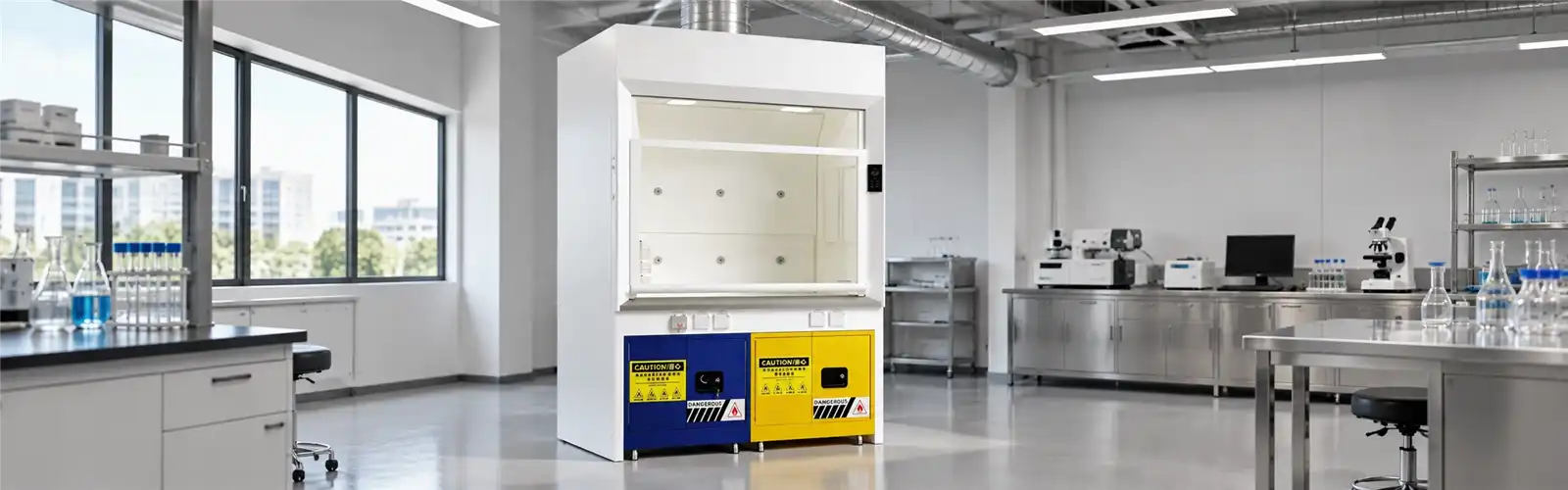
A fume hood and a lab ventilation cabinet are both useful, but they do different things. The cabinet handles the vapors that come from chemicals that are stored in closed containers, and the hood collects the fumes that are made when work is being done at the source. For chemicals that don't change much, a standard storage cabinet might be enough, but neither type of cabinet can be used instead of a hood. To make a good choice, you should look at more than just size or price. You should also look at SDS data, storage volume, ventilation method, airflow design, and overall cost. Ducted and ductless options have different filter limits and site needs. Some common mistakes people make are storing bottles in the hood or not paying attention to the filter capacity. When it comes to durability, the thickness of the steel, the coating, the inner lining, the glass, and the packaging are all important. A trained professional confirmed that many labs benefit from using both units.
No. Vapors from closed, stored containers are controlled in a laboratory fume hood. A hood contains fumes as they are produced during vigorous operations such as mixing or heating.
It is generally unsuitable for storage. Bottles and waste can restrict airflow, reduce containment and increase fire and exposure hazards.
No. Low volatility chemicals tightly sealed in a well-ventilated environment may not require it. Depends on your risk assessment and SDS info.
No, Filter media and capacity will vary depending on the chemical, therefore you will want to evaluate compatibility, breakthrough risk and cost of replacement.
Send us your list of chemicals or SDS files, container sizes, capacity needed, installation requirements, standards and customization needed.
Use design, chemical load, supplier recommendations and local requirements. Check seals and filters, fans and alarms on that timetable.
Uken is a lab ventilation cabinet supplier with 100 professional engineers, ISO, CE, SEFA, and SGS certifications, and standard 1200, 1500, and 1800 mm models. Send us your chemical list, size needs, and shipping destination, and we will recommend a fit. Email service@ukenlab.com, message WhatsApp +8615102909133, or visit ukenlab.com for details.
1. Prudent Practices in the Laboratory: Handling and Management of Chemical Hazards, National Academies Press, 2011
2. Occupational Exposure to Hazardous Chemicals in Laboratories (29 CFR 1910.1450), Occupational Safety and Health Administration, 1990
3. NFPA 30: Flammable and Combustible Liquids Code, National Fire Protection Association, 2021
4. ANSI/AIHA Z9.5: Laboratory Ventilation, American Industrial Hygiene Association, 2022
5. ANSI/ASHRAE Standard 110: Method of Testing Performance of Laboratory Fume Hoods, ASHRAE, 2016
6. OSHA Laboratory Safety Guidance (OSHA 3404-11R), Occupational Safety and Health Administration, 2011