


Feb 6, 2025
NovaLab Tech Solutions
"Responsive and professional supplier with excellent product quality. Communication was efficient, and the entire purchasing process was smooth and reliable."


A well-designed lab ventilation cabinet fits the space without obstructing pathways, draws air via regulated holes, and removes vapours via a duct or filter. Stable airflow, a secure exhaust route, and a layout that provides room for access and maintenance are the three pillars of good design. There are restrictions on the cabinet as well. It controls chemical vapours, however it doesn't take the place of an authorised flammable storage cabinet or fume hood. I go over airflow, exhaust, planning, selection, and what to ask a provider before placing an order in this tutorial.
Air enters via regulated holes, travels through the containers that are being stored, and exits through an exhaust port. That air is drawn in by a fan or building exhaust, which maintains a little lower pressure inside than outside. When the door is closed, this little pressure differential helps prevent vapours from escaping. Door seals, leaks, how often the cabinet is opened, and how well the exhaust is balanced all affect actual performance. Instead of looking for maximal airflow, I advise purchasers to search for predictable airflow. While too little suction allows odours to develop, too much suction wastes conditioned room air and adds noise.
Request the data supporting any airflow claim. Airflow volume, pressure differential, exhaust connection size, fan capacity, system resistance, and noise are the primary factors. A fan that performs well on a test bench may not function as well on the job site due to resistance added by long duct lines, elbows, and dampers. To prevent abrupt decreases that result in turbulence, match the duct to the connection size. The same principles apply here as they do in ANSI/ASSP Z9.5, which addresses laboratory ventilation as a unified system. Verify who tests the system after installation and request documented data.
The way air travels is altered by what you store. The interior passage is blocked by solid shelves that are stacked edge to edge, creating dead zones where vapours gather. Exhaust slots may be covered by large containers pressed against the rear wall. I advise keeping tall containers away from the exhaust hole and creating a space around bottles. Because glass reagent vials are heavy, also check the shelf load ratings. Spill trays should be placed underneath containers without obstructing airflow. After every refill, a brief loading schematic is shown inside the door to assist personnel in maintaining a consistent arrangement.
Vapours are continually removed using a ducted configuration that connects the cabinet to a building exhaust system. When a safe discharge site and an appropriate duct route are already in place, it functions effectively. An appropriately sized fan, access for inspection, early communication with the HVAC team, and duct material appropriate for the vapours are all necessary for the ventilation cabinet exhaust connection. For flammable liquid storage cabinets, NFPA 30 does not mandate venting; if you do, the duct must flow outside without compromising the cabinet's fire resistance. Avoid placing the discharge point near walkways and air intakes. Weak exhaust is often caused by poor duct routing.
Ductless units suit rooms with no duct path, because they filter the air and return it to the room. The catch is the filter. Activated carbon adsorbs certain organic vapors, but it loses capacity as it saturates, and it does not treat every chemical equally. HEPA media captures 99.97% of 0.3 micron particles, yet it does not capture gases or vapors. A ductless cabinet therefore needs the right media for your chemicals, a saturation monitoring plan, and a budget for replacement filters and disposal. Ask the maker for chemical-specific filter data before you buy.
Start with your building. If a compatible exhaust system exists and your chemical list is broad, ducted usually gives steadier removal with less filter upkeep. If the room has no duct path and the chemical list is narrow and well known, a filtered design can work. Compare installation cost, energy use, filter cost, maintenance labor, compliance, and disposal over several years, not only the purchase price. Energy matters because exhausted air must be replaced with conditioned air. I advise buyers to record the choice in the project file so the next facility manager understands the reasoning.
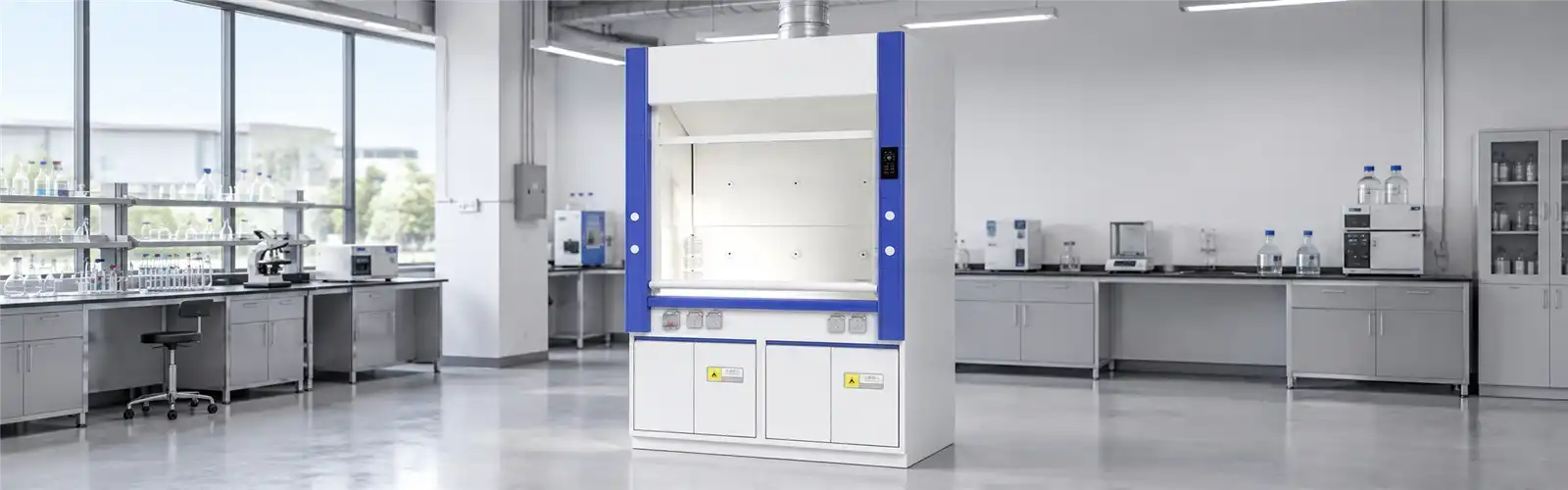
Solvents, acids, flammables, oxidizers, and corrosives have different storage needs, and some should never share a cabinet. Ventilation does not remove the need for segregation. Review each material against its safety data sheet, then compare it with the steel, coating, lining, shelves, trays, fasteners, and duct fittings of any chemical ventilation cabinet or solvent storage ventilation cabinet you consider. Concentration, temperature, humidity, and cleaning agents all affect how long those surfaces last. OSHA's laboratory standard, 29 CFR 1910.1450, requires a chemical hygiene plan, and your storage layout belongs in it. Do not assume a ventilated cabinet carries a fire rating unless the documents say so.
At Uken, we build our lab ventilation cabinet as a full steel structure with an outer steel plate of at least 1.0 mm. We laser cut, bend, and weld the parts, which reduces weak seams. Before coating, we pickle and phosphate the steel, then apply epoxy powder coating at 70 μm or thicker to protect against acid spills, alkaline solutions, and organic solvents. The interior uses 5 mm antibacterial board or another corrosion-resistant material, and a tempered glass window lets staff check contents safely. Our company holds ISO, CE, SEFA, and SGS certifications, and 100 engineers support design and production.
A ventilated cabinet for hazardous chemicals can include spill containment, adjustable shelves, controlled access, automatic door closing, grounding provisions, airflow alarms, filter monitoring, and clear hazard labels. Not every feature suits every model, so I suggest listing which ones are mandatory and which are optional before you request prices. On our standard units, tempered glass supports safe viewing, and the steel shell stands up to everyday chemical exposure. Tell us if your project needs alarms, special liners, or other options, and our engineers will confirm what we can supply. Ask for any feature in writing.
External size tells only half the story. Check usable shelf area, internal height, door swing, container clearance, spill tray volume, rear service space, and maintenance access. Keep the cabinet clear of exits, fire equipment, walkways, and busy workstations. Coordinate with room supply air, nearby Fume Hoods, and general exhaust, because competing airflows can disturb performance. In a pressure-controlled room, bring the HVAC engineer in early. Confirm the delivery route as well. Doors, elevators, and corridors must pass a cabinet that stands 2350 mm (about 7.7 ft) tall, and the ceiling needs room for any exhaust connection.
| Model | Width | Depth | Height |
|---|---|---|---|
| L1200 | 1200 mm (about 47 in) | 850 mm (about 33.5 in) | 2350 mm (about 92.5 in) |
| L1500 | 1500 mm (about 59 in) | 850 mm (about 33.5 in) | 2350 mm (about 92.5 in) |
| L1800 | 1800 mm (about 71 in) | 850 mm (about 33.5 in) | 2350 mm (about 92.5 in) |
Our lab ventilation cabinet comes in these three sizes. The 1200 mm model suits tighter rooms, while the 1500 and 1800 mm models give more shelf area for larger inventories. We can discuss custom dimensions and colors for projects with fixed layouts or brand color rules. Distributors can stock all three sizes to answer school, clinic, and testing lab requests from one catalog. Measure the room first, then compare the footprint with your required clearances.
Names vary between suppliers, so compare specifications instead of labels like "chemical fume cabinet." A laboratory fume hood is designed for active work such as mixing, heating, and experiments, and ASHRAE 110 describes how to test its containment. A ventilated storage cabinet manages vapors from selected stored chemicals. A standard chemical storage cabinet fits cases where fire protection matters most and venting is not needed. Compare intended use, airflow, filtration, construction, chemical compatibility, testing, maintenance cost, and local rules. If staff will pour, heat, or react chemicals, you need a fume hood.

Use a written process. First, list every chemical with its concentration, state, volatility, corrosiveness, flammability, container size, maximum quantity, and access frequency. Second, turn those hazards into requirements for airflow, pressure, filtration, materials, shelf load, and monitoring. Third, check your exhaust, power, room dimensions, access routes, and service space. Fourth, request technical data, test results, installation guidance, maintenance schedules, warranty terms, and conformity documents. Last, price the full cost, including installation, energy, filters, inspection, training, and disposal. This order ties each decision to real risk instead of catalog appearance.
Check the cabinet at the factory and again on site. Verify dimensions, exhaust connection, door operation, labels, alarms where fitted, spill containment, and supplied documents. Installation planning covers floor loading, wall strength, delivery routes, service clearance, electrical connections, and leveling. After startup, inspect airflow, ducts, filters, door seals, shelves, trays, corrosion, and residue on a set schedule. Typical faults include weak exhaust, turbulence, wrong filter media, blocked shelves, incompatible chemicals, and poor duct routing. Keep a log so trends show up early. In the US, confirm requirements with your authority having jurisdiction and your environmental health and safety office.
A complete RFQ shortens the quote cycle. Include the chemical inventory, safety data sheets, required dimensions, site drawings, exhaust conditions, applicable standards, delivery location, schedule, and training needs. Distributors and OEM buyers should also ask about production capacity, quality systems, export packaging, documentation, and repeat-order support. At Uken, we pack each unit for long-distance shipping and can discuss custom sizes, colors, and OEM projects. Ask for copies of the ISO, CE, SEFA, and SGS certificates, and check which ones your local authority accepts, since requirements differ by country and by state.
A safe lab ventilation cabinet design starts with steady, predictable airflow, a suitable exhaust path, and a layout that leaves room for access and service. Ducted systems give continuous removal when the building supports them, while filtered units depend on the right media and monitoring, since HEPA captures particles but not vapors. Materials, coatings, and linings must match the stored chemicals, and ventilation never replaces segregation or approved flammable storage. A ventilation cabinet stores chemicals, whereas a fume hood handles active work. Usable capacity, clearances, and delivery routes matter as much as outside dimensions. A written chemical inventory, verified documents, site checks, and routine inspections turn those points into a cabinet that performs as planned.
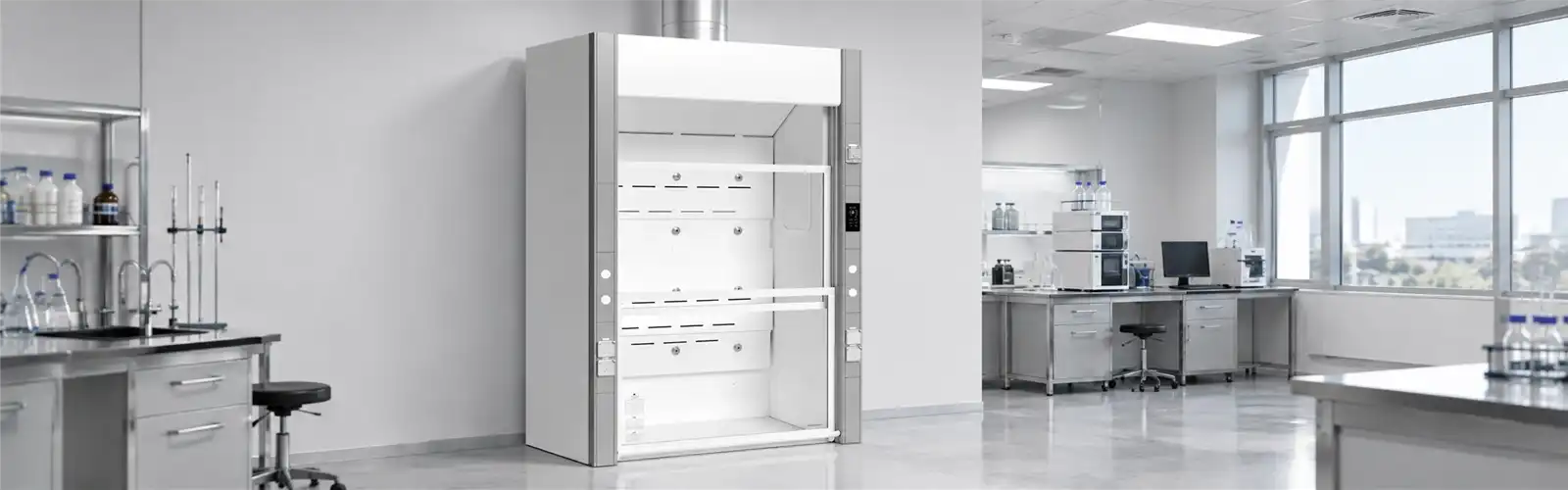
No. A fume hood is built for active work such as mixing and heating. A lab ventilation cabinet is meant for controlled storage and vapor removal. Do not use it for experiments unless the maker documents that use.
Choose ducted when your building has a compatible exhaust system and a safe discharge path. Choose filtered when ducting is impractical, but plan for filter changes and saturation checks. Your chemical list decides the filter type.
No. HEPA media captures particles, not gases. Activated carbon can adsorb certain organic vapors, though it saturates over time.
Share chemical categories, container sizes, storage quantities, room dimensions, exhaust conditions, project quantity, and destination.
Planning a project or stocking your catalog? Uken is a lab ventilation cabinet manufacturer offering 1200, 1500, and 1800 mm models, custom colors, and strict export packaging. Send your chemical list, room size, exhaust details, quantity, and destination to service@ukenlab.com, or message WhatsApp +8615102909133.
1. Prudent Practices in the Laboratory: Handling and Management of Chemical Hazards, National Research Council, 2011
2. NFPA 30: Flammable and Combustible Liquids Code, National Fire Protection Association, 2021
3. ANSI/ASSP Z9.5: Laboratory Ventilation, American Society of Safety Professionals, 2022
4. ANSI/ASHRAE Standard 110: Method of Testing Performance of Laboratory Fume Hoods, ASHRAE, 2016
5. Laboratory Safety Guidance, Occupational Safety and Health Administration, 2011
6. Guidelines for Laboratory Design: Health, Safety, and Environmental Considerations, 4th Edition, Wiley, 2013