


Feb 6, 2025
NovaLab Tech Solutions
"Responsive and professional supplier with excellent product quality. Communication was efficient, and the entire purchasing process was smooth and reliable."


Stable face velocity, appropriately proportioned exhaust and make-up air, suitable ductwork and controls, documented testing, and a hood cabinet that resists chemical exposure are the five interrelated variables that determine fume hood ventilation design. Operators breathe what the hood should catch when one component fails, weakening containment. The best projects, in my experience with laboratory buyers and builders, handle the hood, fan, ducts and building controls as a single system. This guide explains which U.S. standards apply, how each element functions, and how to assess a provider before making a purchase.
One component of a longer exhaust route is a laboratory fume hood. The air within the hood is shaped by the enclosure, sash, and baffles. Contaminated air is transported by ductwork to an exhaust fan, where it is released over the roof via a discharge stack. While sensors and controllers track performance, make-up air replenishes what the hood eliminates. The sash aperture allows room air to enter, travel over the work surface, and then depart via the baffle slits at the back. The operator and the chemical process are separated by this inward flow. The whole fume hood ventilation system becomes unstable if any part is inadequate or clogged, thus I always check the entire route instead than just the cabinet.
Ducted hoods are often used for hazardous, corrosive, or changeable chemical applications since they vent air outside. Air is drawn through filters and returned to the room by ductless units. Because filter media has a limited capacity for each chemical and saturated media might leak impurities, Prudent Practices in the Laboratory warns that filtering is only appropriate for well-defined applications. Ductless hoods need close observation and frequent filter replacements, but they save ducting and conditioned air. I suggest a ducted design when a lab deals with a wide variety of reagents or when the compounds change often. Ductless units are suitable for specific, specified operations, such weighing a single chemical that has been certified.
These two gadgets address distinct issues. By drawing room air through the sash and expelling it, a chemical fume hood shields the operator from dangerous vapours, fumes, and particles. In order to protect humans and often the product from biological hazards, a biological safety cabinet filters air using HEPA. Chemical vapours cannot be controlled in the same manner by a biosafety cabinet or a fume hood. A detailed risk assessment including the agents, amounts, and processes should be the first step in the selection process. This document avoids costly replacements later on and indicates which control belongs in the room.
The speed at which air passes through the sash hole is known as face velocity. A working range of around 80 to 120 feet per minute (0.4 to 0.6 m/s) is often mentioned in laboratory ventilation guidelines. While too much velocity produces turbulence that may force impurities in the direction of the operator, too little velocity hinders capture. The calculation for exhaust volume is straightforward: opening area times face velocity. 0.5 m³/s, or around 1,060 cfm, is needed for a sash opening of 1 m² at 0.5 m/s. Because hood shape and room breezes alter actual performance, engineers test the outcome to validate it.
The structure must provide replacement air since a fume hood eliminates conditioned air from the space. Without it, air rushes through the sash unevenly, doors become difficult to open, and the lab becomes significantly negative. Containment is harmed by the disturbance. Air flows into laboratories rather than out of them because they typically operate at a slightly negative pressure compared to nearby corridors. Supply diffusers are positioned away from hood faces, supply air velocity is kept low, and controls are used to connect supply to exhaust. To make sure the room maintains its pressure objective, I suggest contractors to simulate many situations, such as all hoods open and the majority of hoods inactive.
Airflow is shaped as much by the hood's inside as by the fan. Baffles avoid dead zones where vapours gather by distributing air over the whole work area. After repeated chemical exposure, a corrosion-resistant baffle maintains its form and slot openings, allowing for constant airflow patterns. The air curtain at the sash may be disturbed outside the hood by cross-drafts from doors, supply diffusers, and foot activity. Room air movement near the sash is kept low by well-designed fume hood ventilation patterns. Because bulky goods at the back slots obstruct the flow, put the hood away from doors and busy aisles and keep an eye on equipment placement within.
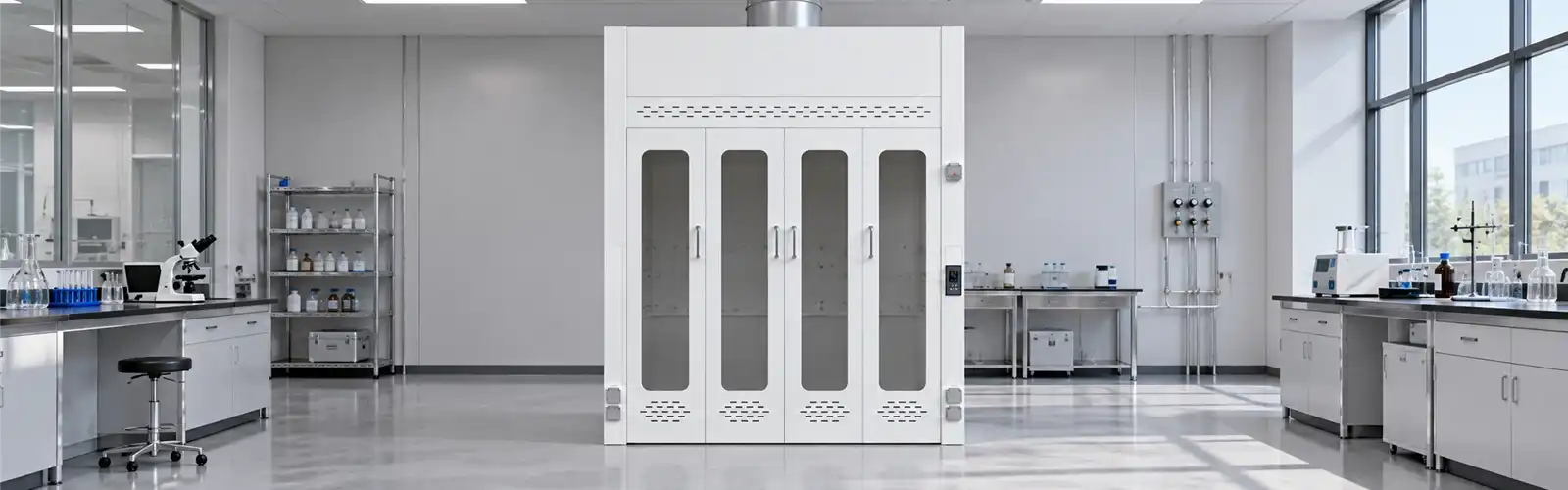
Build the ductwork from materials resistant to the chemicals used, include access points for inspection, and size it at a velocity that minimises noise and pressure loss. Before choosing a fan, designers compute the total static pressure of the whole run since each elbow and transition increases resistance. The choice of fan is also influenced by temperature, chemical exposure, and airflow. In order to prevent exhaust from returning to the building, the discharge stack at the roof must clean air intakes and take wind patterns into consideration. Verify requirements for fire safety and laboratory exhaust materials early in the design process as they may be added by NFPA 45 and local regulations.
Regardless of the sash position, a constant air volume (CAV) system exhausts the same airflow. As the sash moves, a variable air volume (VAV) system modifies the exhaust to maintain a constant face velocity while reducing airflow when the sash shuts. According to the U.S. Department of Energy, ventilation accounts for a large portion of the energy consumption in labs, which is many times more per square foot than that of ordinary office buildings. Although reaction time and sensor calibration are important, VAV helps reduce it. When someone opens the sash, a sluggish control loop may leave a vulnerability. Instead than depending just on the data sheet, confirm reaction times during commissioning.
Every hood should display its operating status. A face velocity monitor with an audible and visual low-flow alarm tells users when containment weakens, and a building automation system can trend that data. Engineers typically connect hood controllers to the building automation system through standard signals such as 4–20 mA, Modbus, or BACnet. Mismatched protocols cause some of the most frustrating commissioning delays, so settle the communication standard during design. If your project uses a specific control brand, send us the requirements, and our engineers will review the cabinet side against your drawings.
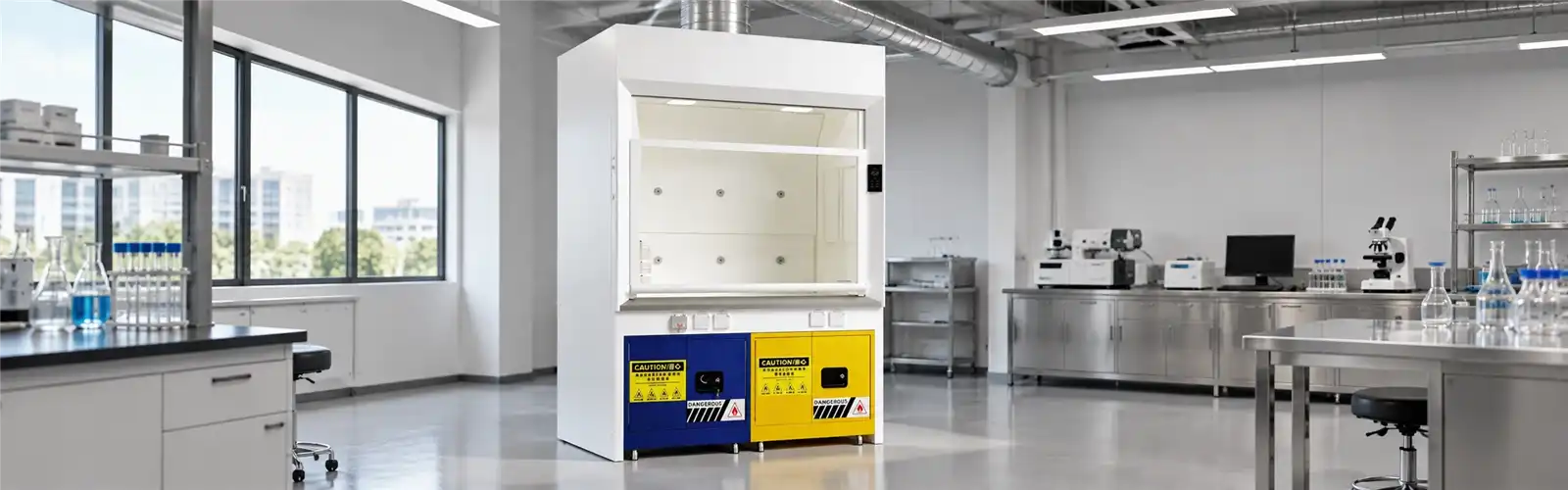
Installation touches architectural, mechanical, electrical, plumbing, and furniture trades, so early coordination saves rework. Place hoods away from doors, windows, supply diffusers, and busy walkways to reduce cross-drafts. Leave service clearance around the cabinet, support ductwork properly, and keep inspection access at fans and dampers. Check utility locations and floor loading before delivery. Modular cabinets help here because they arrive in compact packaging and assemble on site without wooden components, so crews handle fewer large pieces in tight corridors. A clear installation sequence also limits the time a lab stays out of service.
Testing turns design assumptions into evidence. ASHRAE 110 describes a method for testing laboratory Fume Hoods that includes face velocity traverses, smoke visualization, and a tracer gas containment test. The standard defines three stages: as manufactured, as installed, and as used. U.S. owners also work under OSHA's Laboratory Standard, 29 CFR 1910.1450, which requires a Chemical Hygiene Plan and requires that fume hoods function properly. Record each test result, including sash position, instrument calibration, and room conditions. Buyers on international projects may specify EN 14175, so confirm which standard the specification names and request matching documents.
Routine inspection keeps containment stable. Check the sash mechanism, baffles, sensors, alarms, fan belts, bearings, dampers, and room pressure on a set schedule. When face velocity drifts or an alarm triggers, look for root causes such as blocked ducts, a misaligned damper, drifting sensor calibration, or inadequate make-up air, instead of just raising fan speed. Base upgrade decisions on measured performance, not age. Persistent containment failures, corroded ducts, or obsolete controls justify a retrofit or replacement. Plan phased work, temporary containment, and recommissioning so researchers lose as little bench time as possible.

Define the scope first: hood only, hood plus controls, or a full replacement. Then send the supplier your chemical list, hood dimensions, airflow targets, electrical requirements, exhaust routing, and the standards in your specification. Ask for data sheets, drawings, material details, test documents, warranty terms, and spare parts availability. Confirm who provides installation guidance and commissioning support. Compare total cost of ownership rather than catalog price, since energy use, maintenance, downtime, and future expansion all affect what you pay over the life of the hood. A supplier that answers these questions in writing usually brings fewer surprises to the site.
Luoyang Youken Laboratory Equipment Co., Ltd. (Uken) builds each hood on a full steel frame. The outer panels use steel of at least 1.0 mm thickness, cut by laser for accurate assembly, and receive an epoxy electrostatic powder coating of at least 70 μm. Cold-rolled steel parts go through acid washing, phosphating, and electrostatic spraying for resistance to acids, alkalis, and corrosion. Inside, a 5 mm antibacterial board lines the chamber, and corrosion-resistant baffles support airflow across the work surface. The tempered glass safety window has rubber buffer protection, and a synchronous belt lift moves the sash without jamming. These features address chemical exposure, cleaning demands, and daily sash use.
We offer three standard widths, and all share the same depth and height.
| Model | Dimensions (W × D × H) |
|---|---|
| Standard | 1200 × 850 × 2350 mm |
| Medium | 1500 × 850 × 2350 mm |
| Large | 1800 × 850 × 2350 mm |
These sizes suit pharmaceutical, chemical, medical, educational, and research laboratories. Our systems carry ISO, CE, SEFA, and SGS certifications, and you can request the documents that match your project. Export orders ship in standardized packaging with a 20–40 day delivery window, along with assembly documents, installation manuals, and video guides. Our 100 engineers support layout planning and online technical help, and we can arrange on-site guidance for larger installations.
Safe fume hood ventilation depends on how well the hood, exhaust path, make-up air, controls, and testing work together. A face velocity in the commonly cited 0.4 to 0.6 m/s range gives a starting point, but baffle geometry, cross-drafts, and room pressure decide whether the hood actually contains vapors. Ducted designs suit variable or hazardous chemicals, while VAV control reduces energy use only when response speed and sensor calibration are verified. ASHRAE 110 testing and OSHA's Laboratory Standard give owners a documented basis for compliance, and scheduled maintenance protects those results over time. Material choices, such as coated steel, corrosion-resistant baffles, and a smooth sash mechanism, affect durability. The practical takeaway is to evaluate the whole system, document performance, and compare lifecycle cost instead of price alone.
Laboratory guidance commonly cites about 80 to 120 fpm (0.4 to 0.6 m/s). The right value depends on hood design, sash position, and test results, so follow your project specification and confirm it through testing.
Ducted hoods suit variable, toxic, or high-volume chemical work because they exhaust outdoors. Ductless hoods fit narrow, well-documented tasks that have compatible filters and monitoring.
ASHRAE 110 covers face velocity, smoke visualization, and tracer gas containment testing. You can run it as manufactured, as installed, or as used.
It can, because exhaust airflow drops when the sash closes. Verify response time and sensor calibration during commissioning to keep containment stable.
Send hood size, chemical list, airflow targets, exhaust routing, applicable standards, and delivery location.
Planning a laboratory project? Uken, a fume hood ventilation manufacturer with 100 engineers, supports contractors and buyers with layout review, documentation, and 20–40-day export delivery. Send your hood dimensions, chemical list, and exhaust requirements to service@ukenlab.com, or message us on WhatsApp at +8615102909133.
1. Prudent Practices in the Laboratory: Handling and Management of Chemical Hazards, National Research Council, 2011
2. ANSI/ASSP Z9.5 Laboratory Ventilation, American Society of Safety Professionals, 2022
3. ANSI/ASHRAE 110 Method of Testing Performance of Laboratory Fume Hoods, ASHRAE, 2016
4. Laboratory Safety Guidance (OSHA 3404-11R), Occupational Safety and Health Administration, 2011
5. NFPA 45 Standard on Fire Protection for Laboratories Using Chemicals, National Fire Protection Association, 2019
6. ASHRAE Handbook: HVAC Applications, Chapter on Laboratories, ASHRAE, 2019