


Feb 6, 2025
NovaLab Tech Solutions
"Responsive and professional supplier with excellent product quality. Communication was efficient, and the entire purchasing process was smooth and reliable."


A chemical exhaust cabinet is a ventilated enclosure that uses ductwork or a filter to remove dangerous vapours, fumes, and aerosols from the user. Three elements are necessary for safe chemical handling in laboratories: a cabinet constructed of appropriate materials, airflow that has been tested and confirmed, and explicit operating guidelines for each user. This article explains how these cabinets operate, which U.S. standards apply, how they differ from laboratory Fume Hoods, and what to look for before making a purchase. I also discuss the Uken unit's construction specifics.
An enclosed or semi-enclosed workstation that collects pollutants at their source is called a chemical exhaust cabinet. Vapours, fumes, aerosols, and odours from processes including solvent dispensing, dilution, sample digestion, weighing, and small-scale reactions are handled by it. In contrast to a chemical storage cabinet, which only holds containers, it actively controls pollutants during handling. It is an engineering control and should not be used in lieu of documented procedures, PPE, emergency preparation, or risk assessment. The cabinet should be included in the Chemical Hygiene Plan required by OSHA's Laboratory Standard, 29 CFR 1910.1450. I consider the cabinet to be one of multiple layers of defence.
Through the sash hole, the cabinet draws air from the room. Vapours are prevented from moving in the direction of the operator's breathing zone by this inward flow. After passing through interior plenums, air leaves via ductwork or, in a ductless system, a filter. Performance is not only determined by cabinet size. Airflow stability, duct pressure loss, fan capacity, discharge design, and sash position all have an impact. For dangerous, unknown, high-volume, or continuous emissions, I suggest ducted models. Since a saturated filter may release the vapours it has absorbed, ductless units need certified filters, breakthrough monitoring, and stringent chemical compatibility regulations. Request a written explanation of these factors from any source.
These cabinets are used in teaching laboratories so that students may handle solvents, bases, and acids under regulated airflow. They are used by pharmaceutical development teams for formulation and chemical synthesis tasks. They are used in environmental testing laboratories for preparing samples using volatile solvents. Industrial quality control teams utilise them for materials testing, while biological research facilities employ them with chemical fixatives and staining reagents. Additionally, the cabinet serves as an additional barrier against cross-contamination in cleanroom and GMP settings. When a single operation requires its own exhaust point or a full-size fume hood would overcrowd the space, a predetermined footprint makes it feasible.
The room, not the cabinet, is described by the air changes each hour. Cabinet exhaust rates and room air changes are two different design factors. Face velocity, opening size, airflow volume, enclosure geometry, and sash location all affect containment. The exact figure is determined by your EHS office and the governing standard, although often stated face velocity objectives for laboratory hoods are between 80 and 120 feet per minute. Static pressure, duct length, elbows, dampers and building balance must all be taken into consideration when choosing a fan. Different fans, materials, or electrical components may be required for acids, bases, corrosive gases, and solvents. Get commissioning documents, alarm verification, and application-specific calculations from a certified ventilation specialist.
Stable airflow, a low-flow warning, a sash indication, spill containment, and chemical-resistant work surfaces are the foundation of a reliable cabinet. Additionally important are service access that restricts exposure and clear labelling. Automatic sash control, digital airflow displays, occupancy sensors, filter breakthrough alerts, data recording, and building management connection are examples of advanced features. Match them to your level of risk since they increase expenses. For instance, simple controls and unambiguous alerts are most beneficial in a teaching lab with rotating students. Before comparing estimates, find out which safety features are standard on a particular model and which need additional extras.
Cabinet selection is influenced by a number of US documents. The Chemical Hygiene Plan and laboratory chemical exposure are covered by OSHA 29 CFR 1910.1450. Fire safety in chemical-using labs is covered by NFPA 45. ANSI/ASHRAE 110 explains how to verify fume hood containment using a tracer gas, whereas ANSI/AIHA Z9.5 addresses laboratory ventilation. For laboratory fume hoods, SEFA 1 offers suggested procedures. Find out from suppliers which test reports are available and how these papers relate to exhaust cabinets, since they are intended for fume hoods. Local fire, electrical, and construction standards are applicable on top of the EHS regulations that universities often impose.
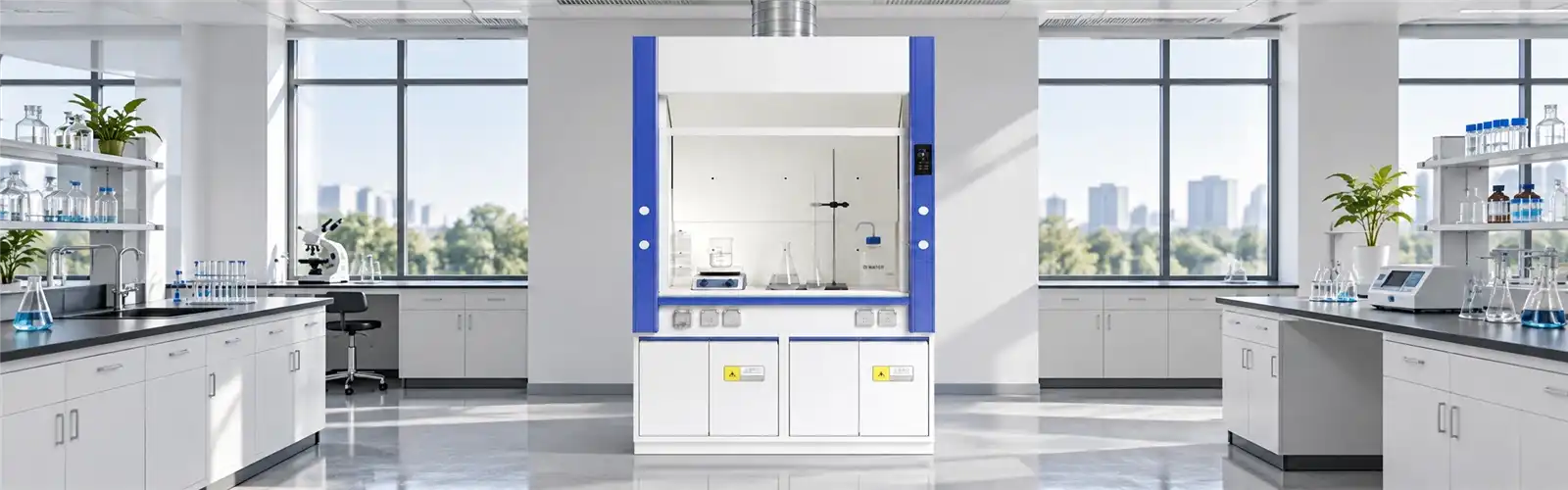
Both devices use local exhaust ventilation, but they suit different workflows. A conventional fume hood gives a larger, more open workspace for apparatus, frequent access, and varied procedures. A chemical exhaust cabinet is often better for compact, enclosed, or process-specific tasks such as chemical transfer, odor control, and small-scale preparation. Compare hazard level, equipment size, operator access, sash design, room layout, ducting, noise, and energy use. Then add the full cost of ownership: installation, fan power, filters, service, downtime, and future changes. Neither choice wins in every case. The process decides.
Size the cabinet around containers, equipment, operator reach, process clearance, and possible expansion. Buyers can compare benchtop, floor-standing, mobile, modular, and process-specific formats, with single or double-sided access and vertical, horizontal, or combination sashes. Sinks, service fixtures, lighting, outlets, removable worktops, and storage zones are common add-ons. A floor-standing unit offers more working height, while a benchtop unit saves floor space. Send the supplier a complete brief covering process, chemicals, utilities, standards, and delivery needs, because custom or OEM designs depend on that information.
Choose materials by the chemicals, temperature, moisture, oxidizing conditions, and cleaning agents involved. Stainless steel, coated steel, polypropylene, PVC, and fiberglass-reinforced plastic each resist different exposures. Coated steel offers strength and impact resistance, and its protection depends on the finish and its thickness. Plastic liners can resist acids and bases but may soften or swell with certain solvents, so check compatibility charts for every reagent. Mixed chemistry calls for the most demanding case, not the average one. Ask for independent chemical resistance data on liners and coatings, and keep a list of your cleaning agents, since disinfectants can attack surfaces too.
Our Uken chemical exhaust cabinet uses a strong, stable steel structure that resists impact. The outer layer is steel plate at least 1.0 mm thick, laser cut and welded. Before coating, we pickle and phosphate the panels. We then apply an epoxy powder finish at least 70 μm thick that resists acids and alkalis. This sequence prepares the metal so the coating bonds and protects against repeated exposure to corrosive chemicals. Uken's cold-rolled steel furniture also contains no wooden components, which supports fire and moisture resistance. The heavy-duty frame holds dense loads such as reagent bottles and analytical equipment without structural deflection.
The inner layer is 5 mm antibacterial board or another corrosion-resistant material. Its smooth, flawless surface resists chemical penetration and leaves no crevices where residues collect, so staff can run full cleaning routines without damaging the interior. The viewing window uses tempered safety glass with rubber buffers, which protect the glass and keep the process visible. The sash lifting mechanism moves smoothly through repeated cycles, which avoids jamming or sash distortion that could compromise sealing. That consistency matters when someone needs to close the sash quickly. Please confirm the exact liner material and airflow options for your project with our engineers.
We offer three standard sizes, all 850 mm (33.5 in) deep and 2350 mm (92.5 in) high:
| Model | Length |
|---|---|
| Model A | 1200 mm (47.2 in) |
| Model B | 1500 mm (59.1 in) |
| Model C | 1800 mm (70.9 in) |
Our OEM/ODM service lets you change dimensions, colors, and functions to fit your building and workflow. Our engineers supply CAD drawings and material certifications to support project approval. Uken has 100 professional engineers and works to ISO, CE, SEFA, and SGS quality standards. Our production scheduling covers small pilot orders and large institutional installations.
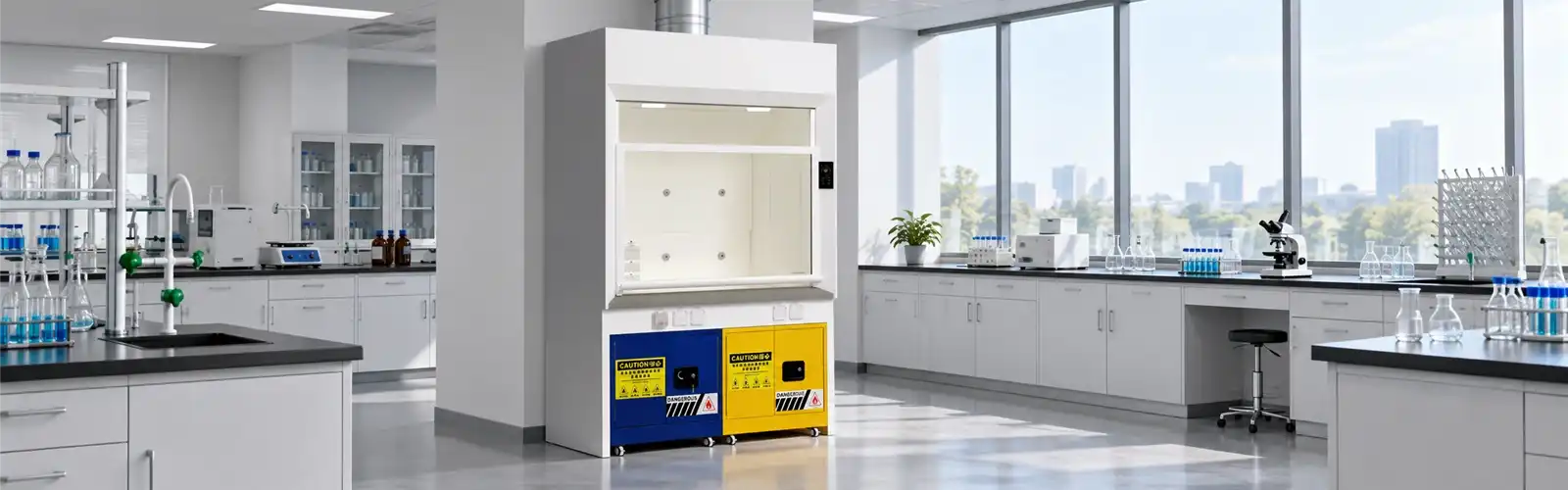
Start with the chemical handling scenario: names, concentrations, quantities, temperatures, volatility, toxicity, reactivity, and whether you heat, mix, dispense, or collect waste. Then set technical criteria for containment, dimensions, sash opening, materials, ducted or ductless operation, noise, ergonomics, and alarms. Avoid common errors: treating an exhaust cabinet like a storage cabinet, buying on price or outer size alone, trusting unverified air change claims, and ignoring material compatibility. Many buyers also overlook make-up air, duct pressure loss, room pressure, and roof discharge limits. Involve HVAC and EHS professionals before you order.
Good installation needs the cabinet maker, HVAC contractor, electrician, facility team, and safety staff working together. Before delivery, confirm dimensions, access routes, floor conditions, utilities, duct materials, exhaust discharge, and maintenance clearance. Specify corrosion-resistant ductwork, proper supports, vibration control, and electrical parts that suit the area. Commissioning should verify airflow, face velocity, smoke visualization, sash operation, alarms, and containment against the chosen standard or manufacturer procedure. Keep the handover file: drawings, test reports, operating instructions, maintenance schedules, emergency procedures, spare-parts information, and warranty terms. A complete file helps the next technician and answers questions during inspections.
A full quotation lists dimensions, configuration, materials, airflow, face velocity, static pressure, fan, filtration, controls, testing, certifications, delivery terms, warranty, installation scope, and spare parts. Verify destination-market compliance, export packaging, factory quality systems, production capacity, and lead time. For custom projects, require drawings, prototype review, and clear acceptance criteria, which prevent disputes at handover. Looking ahead, designs focus on energy efficiency, variable air volume with automatic sash management, digital airflow monitoring, remote alarms, and modular formats. Specify performance data and repairable materials instead of judging by purchase price alone.
A chemical exhaust cabinet protects people by capturing vapors, fumes, and aerosols at the source, but it works only as one layer within a chemical hygiene program. Performance comes from verified face velocity, correct fan and duct design, and compatible materials, not from cabinet size or air change claims. Standards such as OSHA 29 CFR 1910.1450, NFPA 45, ANSI/AIHA Z9.5, and ASHRAE 110 guide selection and testing. A cabinet suits compact, process-specific tasks, while a fume hood suits broader work. Steel strength, coating thickness, lining material, and cleanability decide long-term durability. Careful definition of chemicals, early HVAC and EHS involvement, thorough commissioning, and documented supplier support lead to safer, more predictable installations.

A fume hood offers a larger, open workspace for varied procedures. An exhaust cabinet is usually more enclosed and suits compact, specific tasks. Hazard level and process size should decide.
No. Containment depends on face velocity, opening size, airflow volume, and verified testing, so each application needs its own calculation.
Not automatically. A storage cabinet is built for storage, while an exhaust cabinet controls contaminants during handling. Check your chemical hygiene plan and fire code first.
No. Ductless units need validated filters and breakthrough monitoring, and they suit only chemicals the filter is proven to capture.
Send chemical lists, concentrations, process details, dimensions, site information, applicable standards, quantity, and delivery needs.
Looking for a chemical exhaust cabinet manufacturer that can match your lab layout? Uken offers OEM/ODM customization, ISO, CE, SEFA, and SGS quality standards, and a team of 100 engineers. Send your chemical list, dimensions, and delivery needs to service@ukenlab.com, or message us on WhatsApp at +8615102909133.
1. Occupational Safety and Health Administration, Occupational Exposure to Hazardous Chemicals in Laboratories (29 CFR 1910.1450), 1990
2. National Research Council, Prudent Practices in the Laboratory: Handling and Management of Chemical Hazards, 2011
3. American National Standards Institute and American Industrial Hygiene Association, ANSI/AIHA Z9.5 Laboratory Ventilation, 2012
4. American Society of Heating, Refrigerating and Air-Conditioning Engineers, ANSI/ASHRAE Standard 110: Method of Testing Performance of Laboratory Fume Hoods, 2016
5. National Fire Protection Association, NFPA 45: Standard on Fire Protection for Laboratories Using Chemicals, 2019
6. Scientific Equipment and Furniture Association, SEFA 1: Laboratory Fume Hoods Recommended Practices, 2010